CELPIP Speaking practice test: eight recorded tasks in 15–20 minutes. Preparation is tightly clocked and there is no live examiner mid-task.
Practise these tasks with timers →
Task 1 — Giving Advice
A friend just moved to Kelowna and is concerned about wildfire season. Give them advice on how to prepare for a potential evacuation.
Timing: 30s preparation, 90s speaking.
Sample high-scoring answer
If a friend were visiting the Okanagan during wildfire season, I would give them practical advice based on what I have learned from living here for over a decade. First, download the BC Wildfire Service app before you arrive. It shows active fires, evacuation alerts, and air quality readings in real time, and it is the single most useful tool for staying safe. Second, I would tell them to book accommodation with flexible cancellation policies. Some wineries and hotels offer full refunds if an evacuation alert is issued within twenty-four hours of your stay. Third, have a backup plan. If the air quality in Kelowna becomes hazardous, be ready to drive south to Osoyoos or west to Vancouver where conditions are often better. Pack N95 masks in your car and keep the gas tank at least half full at all times, because evacuation orders can come with very little warning. I would also recommend visiting in early June instead of August if possible, since fires are less frequent and the weather is still beautiful. The Okanagan is a stunning destination, but respecting fire season is part of responsible travel here.
Task 2 — Talking About Personal Experience
Talk about a time you faced an unexpected disruption to your plans and how you adapted. What happened, how did you respond, and what was the outcome?
Timing: 30s preparation, 60s speaking.
Sample high-scoring answer
Last August my partner and I had planned a week in Kelowna to visit wineries and relax by Okanagan Lake. Two days before we left, the McDougall Creek wildfire broke out and the whole region went under an evacuation alert, with hazardous air quality. It was clear our trip was not going to happen as planned. Instead of cancelling everything and feeling disappointed, we pivoted. We found a last-minute campsite near Tofino on Vancouver Island, which has some of the freshest air in the country. We had never been there, and it turned out to be one of our best trips ever. We went storm-watching on Long Beach, ate fresh seafood and hiked through ancient rainforest. I felt terrible for the Okanagan residents affected by the fires, but I was proud of how we handled the disruption. Sometimes the best memories come from plans that fall apart and get rebuilt.
Task 3 — Describing A Scene
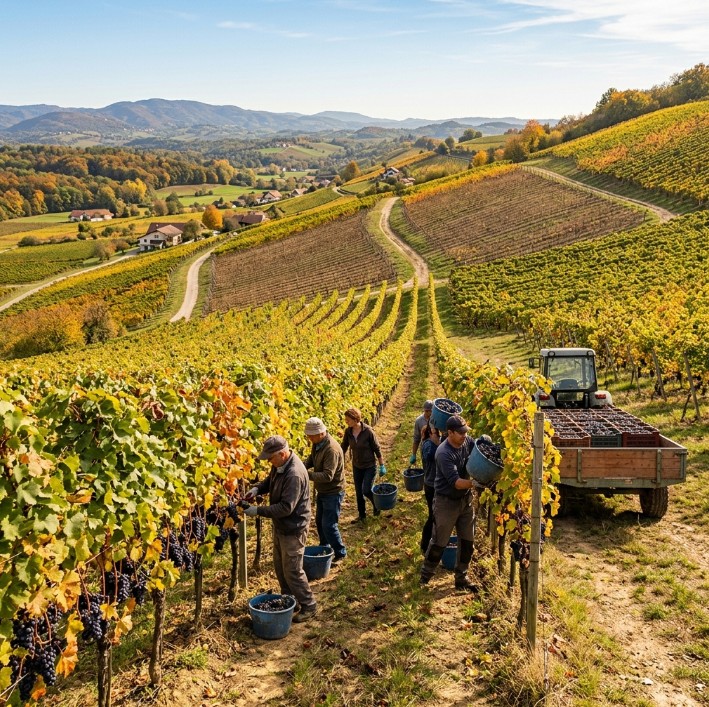
Describe the scene in the picture in as much detail as possible. Talk about the setting, the people, what they are doing and the atmosphere.
Timing: 30s preparation, 60s speaking.
Sample high-scoring answer
This picture shows a vineyard on a hillside during harvest time. The vines are planted in long, neat rows that run down the slope, and the leaves have started to turn, so there is a mix of green and yellow across the field. The grapes are still hanging in heavy bunches under the leaves, and some rows have already been picked, because the vines there look bare. It is a bright, warm afternoon with a clear sky, and the rows stretch away towards the bottom of the hill. In the middle of the vineyard a small group of workers is moving along one row with buckets and crates, bending down to cut the bunches and tipping them in. They look busy but unhurried, and the whole scene feels calm, sunny and productive.
Task 4 — Making Predictions
Look at the same picture again. Predict what happens next in this scene and explain why you think so.
Timing: 30s preparation, 60s speaking.
Sample high-scoring answer
Looking at this same vineyard, I think the next few hours will be the busiest part of the day. The rows that still have grapes will be picked quite soon, because the fruit is already ripe and the weather is warm, so the workers will probably move through the rest of the field before the light goes. Once the bins are full, they will be loaded onto the trailer and taken to the winery, where the grapes will be pressed almost immediately, because the juice has to be processed while it is fresh. By late afternoon I expect the pickers to finish the last row, the machines to fall silent, and the field to be left quiet, with only the empty vines and a few stray grapes on the ground.
Task 5 — Comparing And Persuading
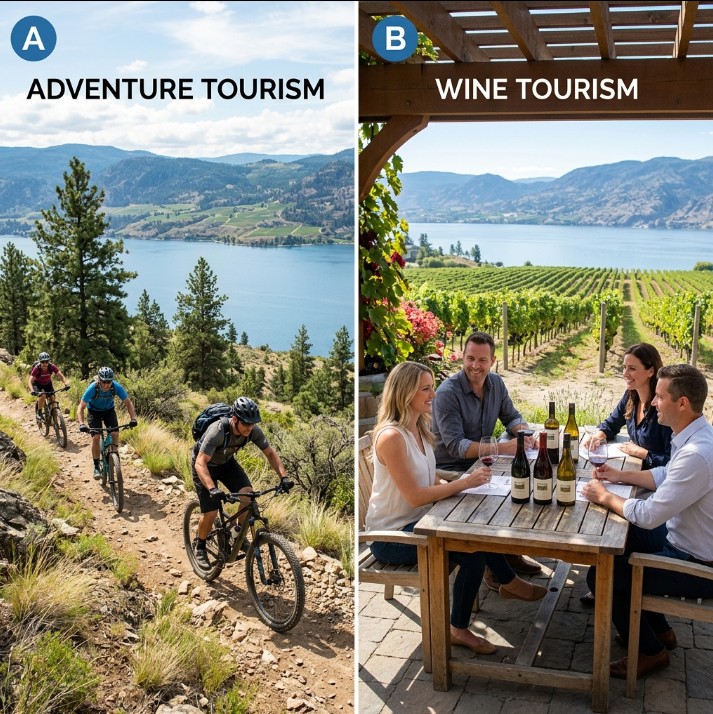
Compare two types of tourism packages for the Okanagan: adventure tourism vs. wine tourism. Persuade which is more beneficial for the local economy. Both options are shown in one picture, labelled A and B. Choose the one you would recommend and persuade the other person to agree with you. Use the picture to support your reasons.
Timing: 60s preparation, 60s speaking.
Sample high-scoring answer
I have visited many Canadian wine regions, and while the Niagara Peninsula deserves its reputation, I believe the Okanagan offers a superior wine tourism experience. The scenery is the obvious difference. Niagara is gentle and pastoral, but in the Okanagan you taste wine against dramatic mountains and a hundred-kilometre lake, which makes every tasting feel like a special occasion. The climate also produces different wines. Hot days and cool nights here create grapes with intense fruit flavours and balanced acidity that are harder to achieve in Niagara's humid conditions. Pinot noir from the Naramata Bench and icewine from West Kelowna are world-class and have won international awards. Niagara has history and proximity to Toronto on its side, and its icewine is excellent. But for landscape, climate and bold wines together, the Okanagan is unmatched.
Task 6 — Dealing With Difficult Situation
Describe a difficult situation you faced as a physiotherapist when treating a forest firefighter with multiple injuries.
Timing: 60s preparation, 60s speaking.
Sample high-scoring answer
I would begin by acknowledging the employee's frustration, because ignoring their emotion only makes things worse. I would say, 'I understand why you feel this way. Rehearsals are a big commitment, and changing the schedule last minute is disruptive.' Once they feel heard, I would explain the reasoning honestly: ticket sales have dropped significantly since the wildfires began affecting tourism, so we consolidated rehearsals to reduce building operating costs. Then I would shift to problem-solving and ask what specific conflicts the new schedule creates. If Tuesday afternoons are impossible because of childcare, could they attend Monday and Thursday evenings instead? I would also offer a written letter confirming their employment and hours for the grant application they mentioned earlier. The key is showing that although the decision stands, I want to minimize the impact on their life. I would check in a week later as well.
Task 7 — Expressing Opinions
State your opinion on whether small businesses in Kelowna are adequately prepared for emergencies like wildfires.
Timing: 30s preparation, 90s speaking.
Sample high-scoring answer
I believe governments in wildfire-prone regions like British Columbia should significantly increase investment in fire prevention, and I say this as someone who has seen the damage firsthand. Prevention is far cheaper than fighting fires. Every dollar spent on controlled burns, forest thinning, and FireSmart community programs saves between three and five dollars in suppression costs later. We already know this, yet our budgets still tilt heavily toward reactive firefighting rather than proactive prevention. I also think prevention should be a shared responsibility. Homeowners in forested areas must be required to maintain defensible space around their properties by clearing dry brush and using fire-resistant building materials. The provincial government should offer subsidies to help cover these costs, especially for seniors and lower-income families. I have seen homes survive fires solely because the owner had cleared a thirty-metre buffer zone, while neighbouring properties burned. Climate change means wildfires are not going away. We can either invest in prevention now and save communities and billions of dollars later, or we can keep reacting to disasters and pretending each one is a surprise.
Task 8 — Describing Unusual Situation
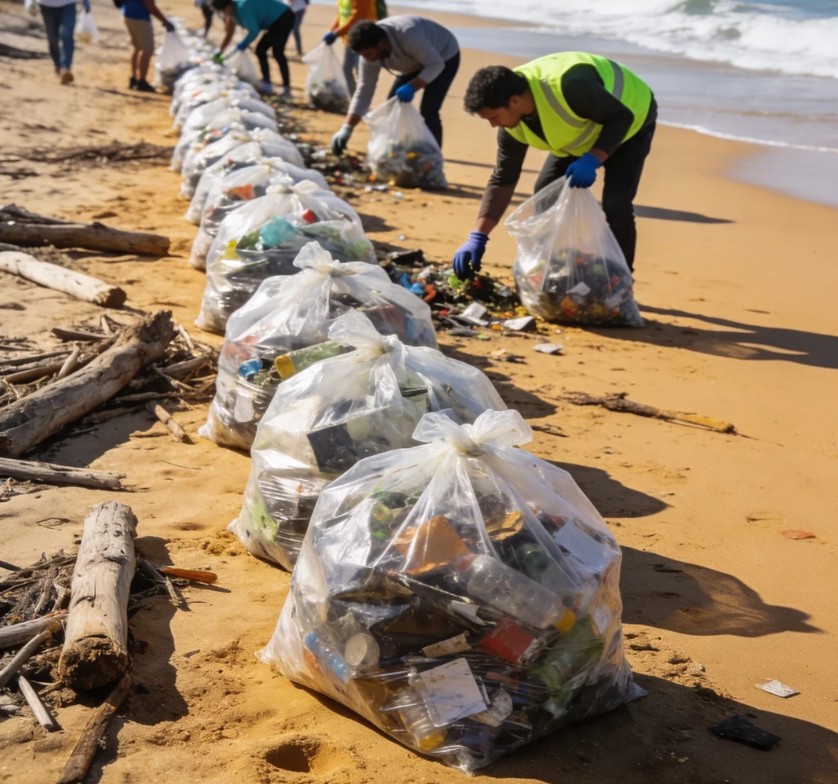
Describe what is unusual or unexpected in this picture. Say what is happening, why it stands out and what you would do in that situation.
Timing: 30s preparation, 60s speaking.
Sample high-scoring answer
What is unexpected in this picture is that a group of people in ordinary clothes are spread out along a beach carrying large bags of rubbish. At first glance it looks like a normal sunny day by the water, with sand, driftwood and small waves, but then you notice that almost everyone is bent over, picking things up and putting them into plastic bags, and the bags are already full and lined up along the sand. Some of them are wearing gloves and bright vests, so they are clearly volunteers rather than council workers. What stands out to me is how much litter has built up on what should be a clean, natural beach. If I were there, I would ask where to get a bag and a pair of gloves and join in for an hour, then make sure my own rubbish never ends up on a beach.