CELPIP Speaking practice test: eight recorded tasks in 15–20 minutes. Preparation is tightly clocked and there is no live examiner mid-task.
Practise these tasks with timers →
Task 1 — Giving Advice
Your friend is moving to Halifax for a new job at the shipyard. They ask for your advice on how to prepare for hurricane season. What advice would you give them? Talk about securing a home, emergency supplies, and community resources.
Timing: 30s preparation, 90s speaking.
Sample high-scoring answer
I would tell my friend to start by getting familiar with the hurricane preparedness guide published by the Nova Scotia government, which is available online, free, and very easy to follow. She should put together a basic emergency kit with bottled water, non-perishable food, a flashlight, extra batteries, a first-aid kit, and all of her important documents stored in a waterproof folder. If she is living near the waterfront, I would strongly recommend that she identify her nearest evacuation centre ahead of time, rather than waiting until a warning has already been issued. I would also suggest she sign up for the city's emergency text alert system, so she never misses an important update. On a practical level, she should get to know her neighbours, because during past storms people on our street have helped each other secure patio furniture, share supplies, and check on elderly residents. Finally, I would tell her not to be too anxious about it. Halifax is a well-prepared city, and if she takes these basic precautions and stays informed, she will feel safe and in control throughout the season.
Task 2 — Talking About Personal Experience
Talk about a time you visited a historic site, museum, or landmark and what you learned from the experience. Where did you go, and why did it make an impression on you?
Timing: 30s preparation, 60s speaking.
Sample high-scoring answer
Last summer I took the ferry from Halifax to visit the Canadian Museum of Immigration at Pier 21. Walking through the exhibits, I was deeply moved by the stories of families arriving in Canada with nothing but a suitcase and hope. One display recreated a ship's dining hall from the 1950s, and I imagined what it must have felt like for a young mother travelling alone with children, not speaking English or French. What struck me most was learning that over one million immigrants passed through those doors between 1928 and 1971, including my own grandmother, who arrived from Italy as a teenager. I found her name in the digital archive and cried. That visit gave me a deep appreciation for the courage it took to start over, and I now take every visitor to Halifax there.
Task 3 — Describing A Scene
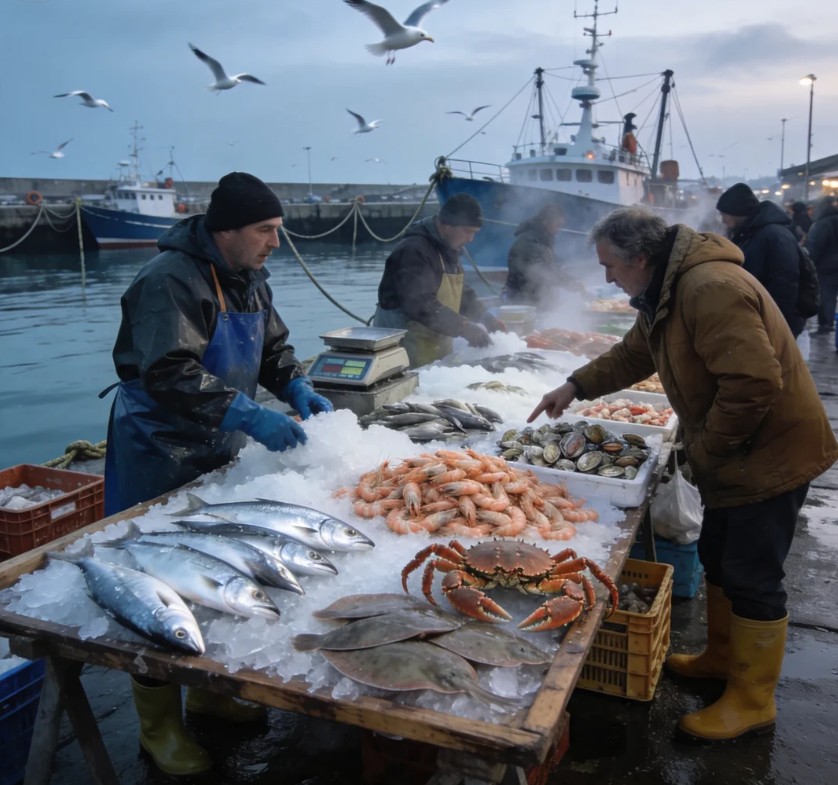
Describe the scene in the picture in as much detail as possible. Talk about the setting, the people, what they are doing and the atmosphere.
Timing: 30s preparation, 60s speaking.
Sample high-scoring answer
It is an early morning at a harbour fish market, and the whole place feels cold, damp and full of activity. The stalls are simple tables and crates set up right beside the water, covered with the day's catch laid out on beds of crushed ice. I can see whole fish with silver scales, flat fish, piles of shrimp and shellfish, and a few large crabs. The sellers are wearing waterproof aprons and rubber boots, and they are busy sorting, weighing and calling out to customers. Buyers in warm coats lean over the ice to inspect what is on offer, pointing at the pieces they want. Behind everything, boats are tied up at the quay and seagulls hover overhead, hoping for scraps. The air smells strongly of the sea. The atmosphere is brisk and practical rather than relaxed, because everyone knows fresh fish has to be sold quickly.
Task 4 — Making Predictions
Look at the same picture again. Predict what happens next in this scene and explain why you think so.
Timing: 30s preparation, 60s speaking.
Sample high-scoring answer
Looking at the same harbour market, I think the scene will change quite quickly in the next hour or two. The fish is laid out on ice in the open air, so the sellers will want to move it before it warms up. As the morning goes on, the best pieces will sell, the ice will melt into puddles on the concrete, and the tables will look emptier and messier. More shoppers will probably arrive, so the stalls will get busier and the sellers will work faster, calling out their prices. Around midday the boats will head back out for the next catch, and the market will slowly wind down. By early afternoon I expect most of the stalls to be packed away and the crates stacked, leaving the harbour quiet again.
Task 5 — Comparing And Persuading
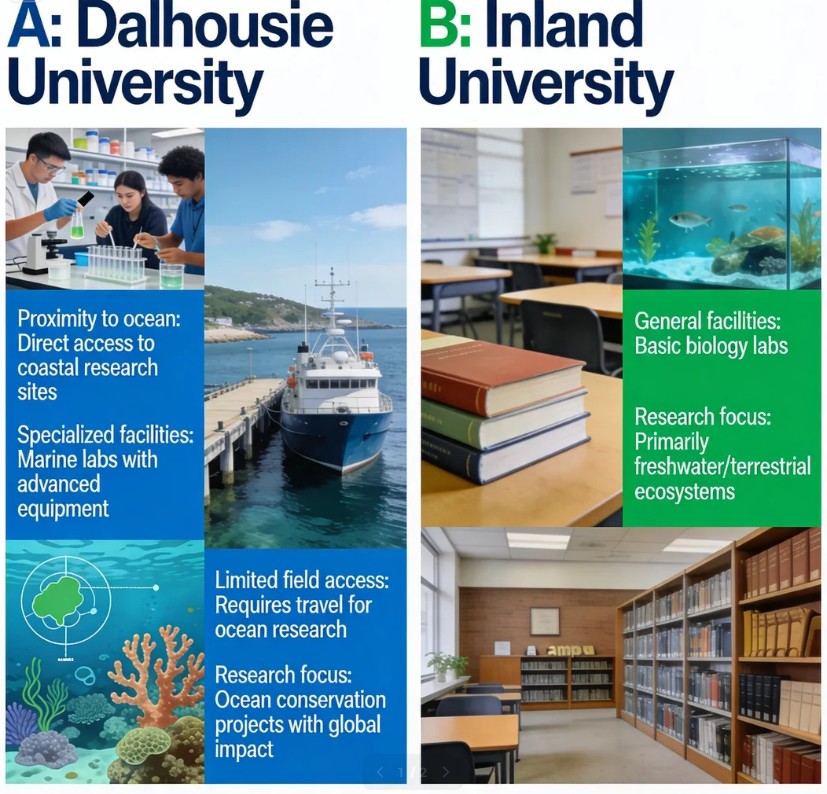
Compare studying marine biology at Dalhousie University with studying at a university inland. Which do you think is better for someone interested in ocean conservation? Persuade the listener. Two options are shown as pictures A and B. Choose the one you would recommend and persuade the other person to agree with you. Use the pictures to support your reasons. Both options are shown in one picture, labelled A and B. Choose the one you would recommend and persuade the other person to agree with you. Use the picture to support your reasons.
Timing: 60s preparation, 60s speaking.
Sample high-scoring answer
I believe Dalhousie University is the stronger choice for someone serious about marine biology. Its location on the Atlantic coast gives students immediate access to the ocean for fieldwork, which no inland university can replicate. Students at Dalhousie can collect samples in the Bedford Basin, study tidal ecosystems within walking distance of campus, and join research voyages with the Bedford Institute of Oceanography. These experiences build practical skills that employers in marine science look for. In contrast, a university in Saskatchewan or Manitoba might offer excellent theoretical coursework, but students must travel long distances for hands-on marine work. Dalhousie also benefits from strong partnerships with government research agencies and private fisheries. While both options can provide a quality education, the coastal advantage gives students a clearer path from classroom to career, so proximity to the ocean should be a deciding factor.
Task 6 — Dealing With Difficult Situation
You are a fisheries officer. A boat owner calls you, upset because a storm has damaged his fishing gear and he cannot afford repairs. How would you handle this situation? Explain what you would say and do.
Timing: 60s preparation, 60s speaking.
Sample high-scoring answer
I would start by letting him speak without interrupting, because people in distress need to feel heard before they can accept help. I would acknowledge how difficult it must be, since his livelihood depends on that equipment. Then I would calmly explain several support programs he might not know about. The provincial Fisheries Emergency Fund offers grants of up to three thousand dollars for gear replacement after a declared storm, and I would offer to help him fill out the application over the phone. I would also mention the equipment loan program at the Fishermen's Mutual Benefit Society, which provides nets and traps on a short-term basis while his grant is processed. Finally, I would give him my direct phone line and follow up in two days. People in crisis need practical solutions, but they also need to know someone cares.
Task 7 — Expressing Opinions
Some people believe that university education is not necessary for a successful career, especially in trades like shipbuilding. What is your opinion? Use examples from your experience or knowledge.
Timing: 30s preparation, 90s speaking.
Sample high-scoring answer
I think university education is extremely valuable, but I do not believe it is the only path to a successful and fulfilling career, especially in skilled trades like shipbuilding and welding. The Halifax Shipyard, for example, employs hundreds of welders, pipefitters, and electricians who earn excellent wages and contribute to an industry that is essential to our regional economy. Many of these workers learned their craft through apprenticeship programs at Nova Scotia Community College, not through a university degree. That said, I do believe education in a broader sense is essential, whether it happens in a classroom, a workshop, or on the job. The key is matching the type of education to the career. A marine biologist absolutely needs a university degree, but a shipbuilder needs hands-on training and certification. What matters most is that people have access to quality training, mentorship, and real opportunities to grow throughout their careers. Canada should invest equally in both university and trade education so that every individual can find their own path to a meaningful and rewarding career.
Task 8 — Describing Unusual Situation
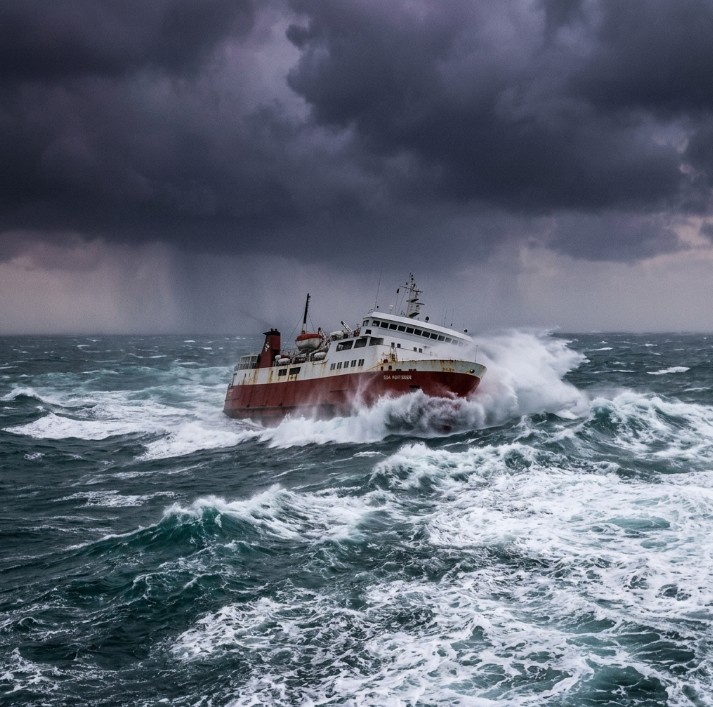
Describe what is unusual or unexpected in this picture. Say what is happening, why it stands out and what you would do in that situation.
Timing: 30s preparation, 60s speaking.
Sample high-scoring answer
What is unusual in this picture is seeing a ferry out in really rough weather, with dark storm clouds and huge waves breaking around it. It stands out because ferries usually travel in calm conditions, and here the sea looks dangerous, with white foam everywhere and the water rising high on both sides of the hull. The boat looks small against the size of the waves, and it seems to be leaning as it pushes through them, which makes the whole scene feel tense and unsafe. The contrast between the heavy, solid vessel and the violent water is what catches the eye. If I were on board, I would stay inside, sit down somewhere stable and hold on, and follow whatever the crew told me. I would not go out on deck for a photo in conditions like that.