CELPIP Speaking practice test: eight recorded tasks in 15–20 minutes. Preparation is tightly clocked and there is no live examiner mid-task.
Practise these tasks with timers →
Task 1 — Giving Advice
Your friend is visiting Whitehorse for the first time and wants to go on a northern-lights tour alone at night. Advise them on safety precautions they should take. You have 30 seconds to prepare and 60 seconds to speak.
Timing: 30s preparation, 90s speaking.
Sample high-scoring answer
Thanks for asking me about this, because a northern-lights tour at night is one of those things where a little preparation goes a long way. My first and most important piece of advice is not to go alone. Always join a guided tour, especially at night, because the terrain can be tricky and moose and other wildlife are often active after dark. If you really do end up going alone, at least tell someone your route and the time you expect to check in. Second, dress warmly in layers, since temperatures up here can drop below minus twenty. Insulated boots, gloves and a hat are not optional. Third, carry a fully charged phone and a flashlight, and bring extra batteries so you are never caught in the dark. Fourth, stick to the marked trails. The permafrost ground is uneven, and wandering off is how people get hurt. Finally, check the weather forecast and the aurora activity before you head out, and if a moose advisory is in effect, follow it carefully. That means staying in your vehicle if you are driving and never approaching the animals. Honestly, if you put your safety first, you will enjoy the experience so much more.
Task 2 — Talking About Personal Experience
Talk about a time you had to take precautions or follow safety guidelines in a natural or outdoor setting. What was the situation, what did you do, and why was it important?
Timing: 30s preparation, 60s speaking.
Sample high-scoring answer
Two winters ago, my family and I were driving from Whitehorse to Dawson City when we hit a sudden whiteout on the Klondike Highway. Visibility dropped to almost nothing in minutes, and it was minus thirty-five outside. My father, who grew up in the Yukon, pulled over immediately and put on our hazard lights. He reminded us that we had packed emergency blankets, a flask of hot tea and extra layers in the trunk. We sat there for nearly an hour, playing word games and listening to CBC Radio for weather updates until the squall passed. When the snow finally eased, we carried on slowly and safely. That taught me never to take northern weather for granted, and my father's preparation likely prevented a dangerous situation. Now I never leave home in winter without checking the forecast and packing an emergency kit, no matter how short the trip.
Task 3 — Describing A Scene
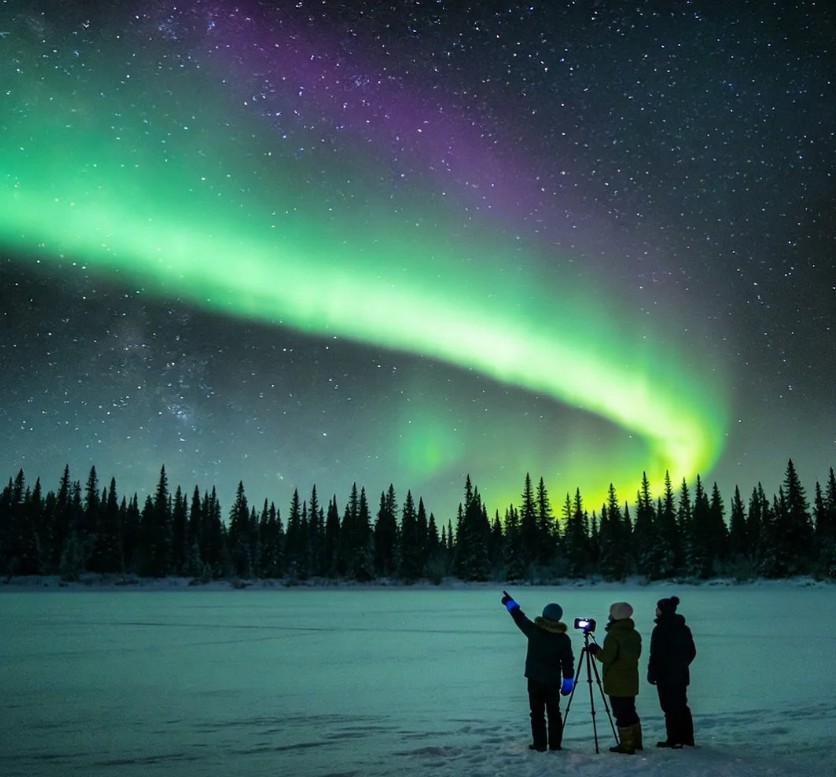
Describe the scene in the picture in as much detail as possible. Talk about the setting, the people, what they are doing and the atmosphere.
Timing: 30s preparation, 60s speaking.
Sample high-scoring answer
The picture shows a night landscape under the northern lights. The sky is almost black but it is full of stars, and a wide band of green light curves right across it, with fainter purple edges near the top. Below, there is a snowy open area, probably a frozen lake or a clearing, and a line of dark spruce trees along the horizon. In the foreground a small group of people stand together, all in heavy winter coats, hats and mittens. Two of them are looking up and pointing, one is holding a camera on a tripod, and the others are just standing still and watching. Everything is lit softly by the aurora, so the snow glows a pale green. It looks freezing, silent and completely calm, and the mood is one of quiet wonder.
Task 4 — Making Predictions
Look at the same picture again. Predict what happens next in this scene and explain why you think so.
Timing: 30s preparation, 60s speaking.
Sample high-scoring answer
Staying with this same scene, I think the next hour or so will follow a fairly predictable pattern. The aurora rarely holds one shape for long, so the band of green light will probably break up and reform, fading almost completely and then brightening again, because these displays come in waves. The people will not stay much longer either. It is very cold standing still in the snow, so after another ten or fifteen minutes I expect the group to drift back towards their cars and vans for hot drinks, while the photographers keep checking their screens. Soon the headlights will disappear down the road and the place will go back to being completely dark and silent, with only the stars and the last of the green glow above the snow.
Task 5 — Comparing And Persuading
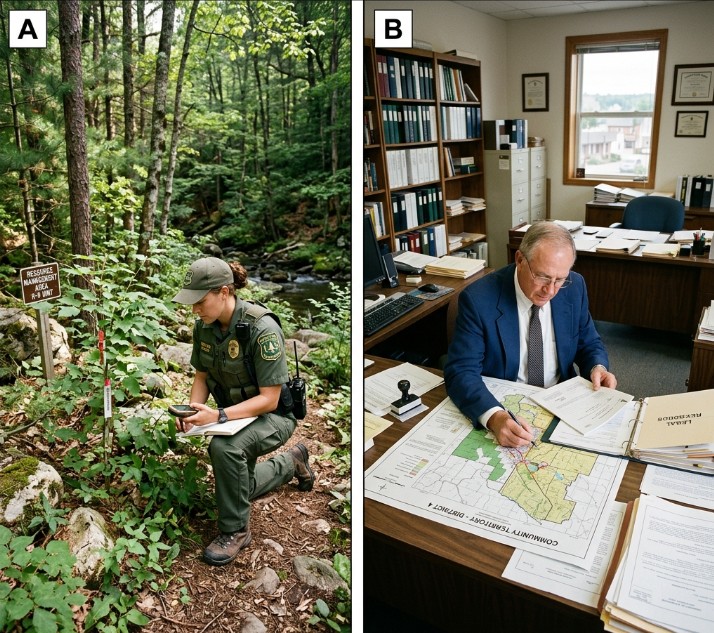
Compare the roles of a wildlife officer and a territorial clerk in managing resource conflicts. Persuade your audience that one role is more critical for the community. You have 60 seconds to prepare and 60 seconds to speak. Two options are shown as pictures A and B. Choose the one you would recommend and persuade the other person to agree with you. Use the pictures to support your reasons. Both options are shown in one picture, labelled A and B. Choose the one you would recommend and persuade the other person to agree with you. Use the picture to support your reasons.
Timing: 60s preparation, 60s speaking.
Sample high-scoring answer
I believe the wildlife officer's role is more critical for the community. While the territorial clerk handles logistics and administration, the wildlife officer directly protects the natural environment and public safety. For example, when moose appear near roads, it is the wildlife officer who assesses the risk and advises on safety measures. Without their expertise, the moose-safety advisory would be less effective, and tourists and workers could be in danger. The clerk supports these efforts but relies on the officer's knowledge. In resource management, conflicts like mining versus conservation need scientific input from wildlife professionals. The officer also educates the community and coordinates with tour operators, fostering sustainable coexistence. While both roles are important, the wildlife officer has a direct impact on our northern identity and well-being. Therefore, I would allocate more resources to the wildlife department.
Task 6 — Dealing With Difficult Situation
You are a territorial clerk. A mining camp manager calls to say a moose has entered the camp and is threatening workers. Explain how you will handle this emergency. You have 60 seconds to prepare and 60 seconds to speak.
Timing: 60s preparation, 60s speaking.
Sample high-scoring answer
This is a serious situation. First, I will tell the manager to keep all workers indoors and away from the moose. Then I will immediately contact the wildlife officer and the local conservation officer, because they have the training and equipment to handle wildlife safely. I will also suggest that the manager make loud noises from a safe distance to try to deter the moose, but only if that is safe to do. Meanwhile, I will work with the camp cook to secure any food sources that might attract the moose further. The wildlife officer may need to tranquilize the animal or guide it away using non-lethal methods. I will also alert nearby tour operators and residents if the moose moves toward populated areas. Afterward, we will review the incident to improve prevention, such as reinforcing fencing and waste management. The priority is human safety and animal welfare.
Task 7 — Expressing Opinions
Give your opinion on whether the government should invest more in permafrost road maintenance or in wildlife conservation. Explain your reasons. You have 30 seconds to prepare and 90 seconds to speak.
Timing: 30s preparation, 90s speaking.
Sample high-scoring answer
In my opinion, the government should invest more in permafrost road maintenance, but not at the expense of wildlife conservation. The road is critical for the local economy. It supplies our mining camps and supports tourism, and without a stable road, industries would suffer and people would lose jobs. However, I believe that maintenance can be done in an environmentally responsible way. For example, using insulating materials and doing the work seasonally minimizes the impact on permafrost and on wildlife. At the same time, wildlife conservation matters just as much for our northern identity and for the health of the ecosystem. Moose and other species bring tourists here and keep the natural balance in place. So I think a balanced allocation is the best answer. Instead of choosing one over the other, the government should invest in road upgrades that incorporate wildlife-friendly designs, such as underpasses and corridors. That way we keep our infrastructure working while protecting the animals and the land they depend on. It is not an either-or situation at all. A sustainable approach benefits everyone, so funding should go to projects that integrate both objectives and create a real win-win for the whole community.
Task 8 — Describing Unusual Situation
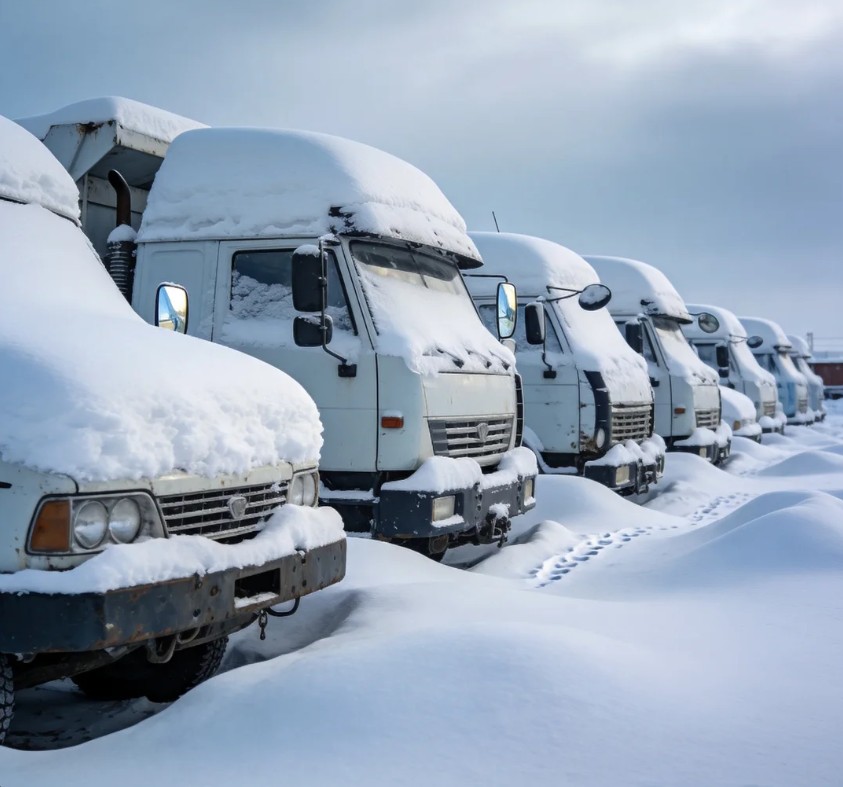
Describe what is unusual or unexpected in this picture. Say what is happening, why it stands out and what you would do in that situation.
Timing: 30s preparation, 60s speaking.
Sample high-scoring answer
What strikes me as unusual in this picture is the row of trucks at what looks like a work site, all buried under a thick layer of snow. The snow has built up on the bonnets, roofs and mirrors until the vehicles look almost like white mounds, and there are no tyre tracks or footprints anywhere around them, so the site seems to have been idle for a long time. That is what stands out: heavy trucks are expensive working machines, and normally they would be in use or at least cleared off, so seeing them left like this suggests work stopped suddenly, perhaps because of a storm. If I came across this, I would not try to start or move any of them. I would check whether anyone was still on site and report it to the site manager for a proper inspection.