CELPIP Speaking practice test: eight recorded tasks in 15–20 minutes. Preparation is tightly clocked and there is no live examiner mid-task.
Practise these tasks with timers →
Task 1 — Giving Advice
Your friend is visiting Ottawa for the first time during Winterlude. Give them advice on how to make the most of their trip, including transportation, attractions, and clothing. You have 30 seconds to prepare, then 60 seconds to speak.
Timing: 30s preparation, 90s speaking.
Sample high-scoring answer
If a friend were visiting Ottawa for the first time during Winterlude, I would tell them to start their day early and take OC Transpo Routes 6 or 7 to Parliament Hill, because those routes offer frequent service. Winterlude is best enjoyed with proper winter clothing, so I would insist on a heavy coat, waterproof boots, and extra socks. The Rideau Canal Skateway is a must, but they should rent skates from a kiosk rather than carrying their own. They should also visit the ice sculptures in Confederation Park and try a beavertail from one of the vendors. To avoid the long lines, I would suggest going to the snow slides at Jacques Cartier Park right when they open at nine in the morning. They should check the OC Transpo website for any service changes, and plan their route in advance to maximize the fun and minimize waiting in the cold. I would also suggest taking advantage of the free walking tours organized by the Friends of the Central Experimental Farm, which provide historical context and help visitors appreciate the design and purpose of that beautiful green space.
Task 2 — Talking About Personal Experience
Talk about a time you attended a meeting, workshop, or community event that changed your perspective on an issue. What was the event, and what did you learn?
Timing: 30s preparation, 60s speaking.
Sample high-scoring answer
Last spring, my neighbourhood association in Ottawa organized a workshop about urban tree planting. I went mainly because my next-door neighbour asked me to join her, and honestly, I expected it to be boring. The presenter was a forestry expert from the University of Guelph who explained how mature trees reduce air conditioning costs, absorb stormwater runoff, and even increase property values. She showed before-and-after photos of streets transformed by tree-planting programs. What struck me most was learning that our neighbourhood had lost nearly twenty percent of its tree canopy in the past decade because of development and disease. After the workshop, I volunteered at a tree-planting event, and now I sit on the association's green committee. That evening changed how I see my own street, and it taught me that the most valuable experiences often come from saying yes to something you did not expect to enjoy.
Task 3 — Describing A Scene
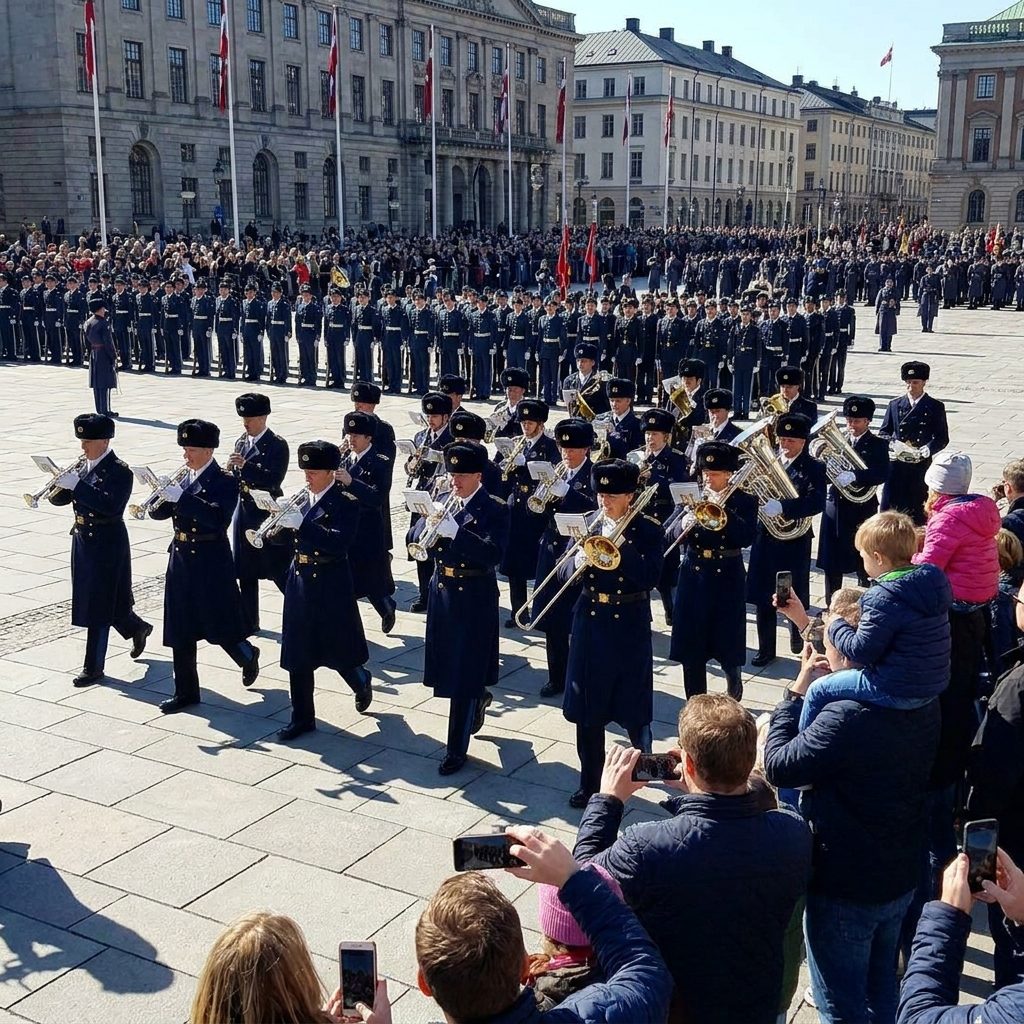
Describe the scene in the picture in as much detail as possible. Talk about the setting, the people, what they are doing and the atmosphere.
Timing: 30s preparation, 60s speaking.
Sample high-scoring answer
The photograph shows a formal parade moving through a wide public square on a bright, clear morning. In the foreground, a long line of marchers in dark uniforms with tall hats and polished buttons advances in step, and several of them carry brass instruments that catch the sunlight. Behind them, a larger group in matching uniforms stands in ordered rows, waiting their turn. On both sides of the route, a dense crowd of spectators has gathered; some are holding up phones to take pictures, and a few children sit on adults' shoulders to see over the barrier. The ground is a broad paved area, and the light is strong enough to cast short, crisp shadows. The mood feels proud and ceremonial, but also relaxed and festive, because people are smiling and chatting while the band plays.
Task 4 — Making Predictions
Look at the same picture again. Predict what happens next in this scene and explain why you think so.
Timing: 30s preparation, 60s speaking.
Sample high-scoring answer
The parade clearly will not stay in one place for long. The band at the front is already in step and facing down the main street, and the crowd behind the barriers is turned that way, so in the next few minutes the marchers will move off and lead the procession out of the square. The spectators will drift along the sidewalk beside them, and the officers at the edges will close off the intersections as the group passes. When the marchers reach the end of the route, the formation will break up, the musicians will pack their instruments away, and the square will slowly empty as people head home. Within an hour or so, only the barrier crews will be left, clearing the street.
Task 5 — Comparing And Persuading
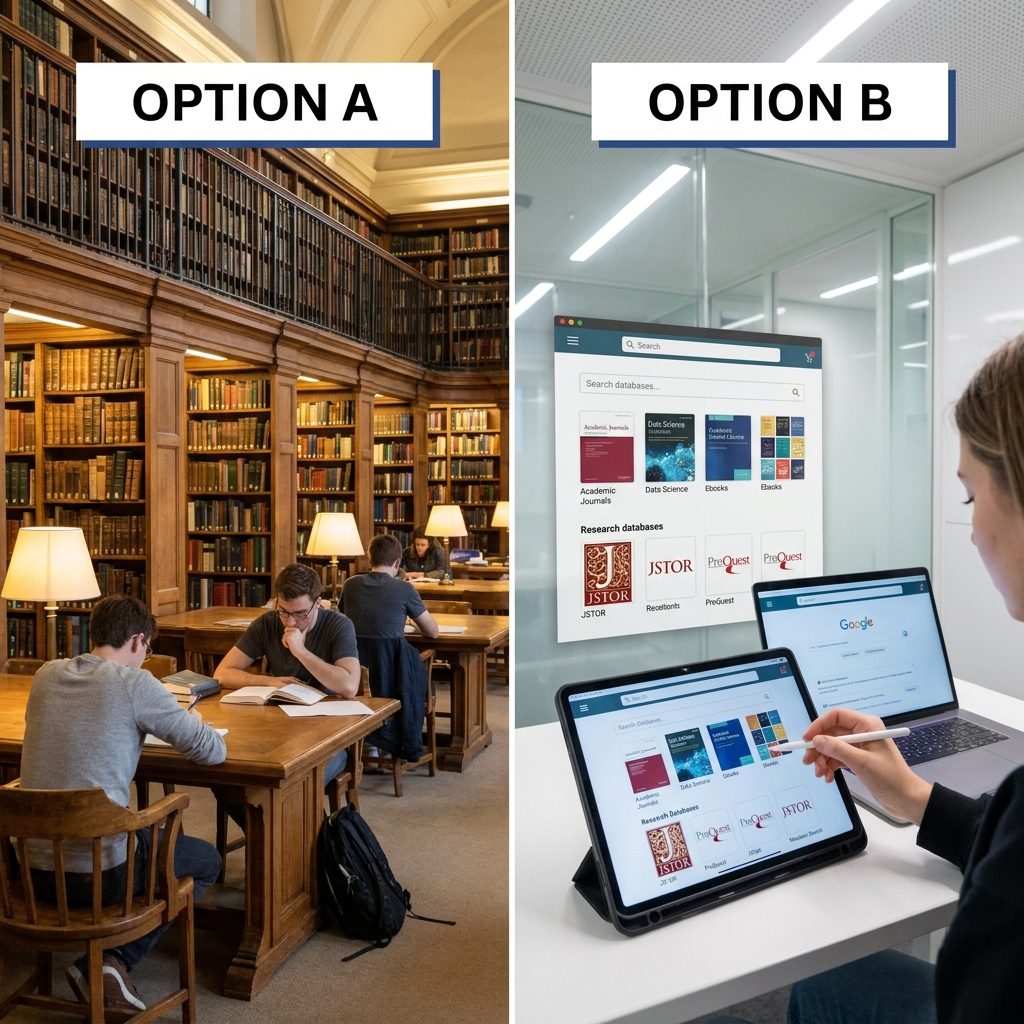
Compare the value of physical library resources (books) versus digital resources (ebooks, databases). Which do you think is more important for a university library, and why? You have 60 seconds to prepare, then 60 seconds to speak. Two options are shown as pictures A and B. Choose the one you would recommend and persuade the other person to agree with you. Use the pictures to support your reasons. Both options are shown in one picture, labelled A and B. Choose the one you would recommend and persuade the other person to agree with you. Use the picture to support your reasons.
Timing: 60s preparation, 60s speaking.
Sample high-scoring answer
Both physical and digital resources are valuable, but for a university library I believe digital resources are more important in today's context. Digital databases and ebooks provide instant access to the latest research, which is crucial for students and faculty. They can be accessed from anywhere, which makes them ideal for remote learning. That said, physical books are still essential for deep reading and for subjects where the primary texts exist only in print. However, the cost of maintaining a large physical collection is high, and many students now prefer digital formats. So I would argue that libraries should prioritize digital subscriptions and archives, while still carefully curating key physical collections. That balance meets the needs of modern users while preserving an important tradition.
Task 6 — Dealing With Difficult Situation
You are a tour guide. A visitor approaches you angrily because their Parliament Hill tour was canceled due to a security issue. They are disappointed and demand a refund. What do you say? You have 60 seconds to prepare, then 60 seconds to speak.
Timing: 60s preparation, 60s speaking.
Sample high-scoring answer
I understand your frustration, and I sincerely apologize for the inconvenience. Unfortunately, security issues are out of our control, and the safety of visitors and staff is our top priority. I will immediately process a full refund for you and your group. Additionally, I want to make it right. I can offer you a complimentary voucher for a future tour, which can be used within the next six months. Also, I can give you a free self-guided walking tour map of Parliament Hill so you can still see the exterior and the beautiful winter scenery. If you have time tomorrow, I can personally reserve spots for you on the first tour of the day. I hope this helps. Please feel free to share any other concerns.
Task 7 — Expressing Opinions
Do you think the government should invest more in public transit or roads? Express your opinion and support it with reasons. You have 30 seconds to prepare, then 90 seconds to speak.
Timing: 30s preparation, 90s speaking.
Sample high-scoring answer
In my opinion, the government should invest more in public transit than in roads. Public transit is more sustainable environmentally, because it reduces individual car use and lowers overall emissions. It also promotes equity, since it provides affordable mobility for people who cannot drive, whether because of age or income. Improved transit can ease congestion, which benefits everyone, including those who continue to drive. Ottawa has a growing population, and expanding the O-Train and the bus network would alleviate the pressure on our roads. Of course, roads are necessary for commerce and emergency services, and I admit that expanding highway capacity often just leads to more traffic. Investments in transit, such as electric buses and light rail, tend to have long-term benefits that road expansion simply cannot match. However, I acknowledge that maintaining our existing roads is also necessary. A balanced approach is ideal, but I believe new funding should tilt toward public transit, so that we can achieve our climate goals and create more livable cities. I believe that investing in transit is an investment in our future.
Task 8 — Describing Unusual Situation
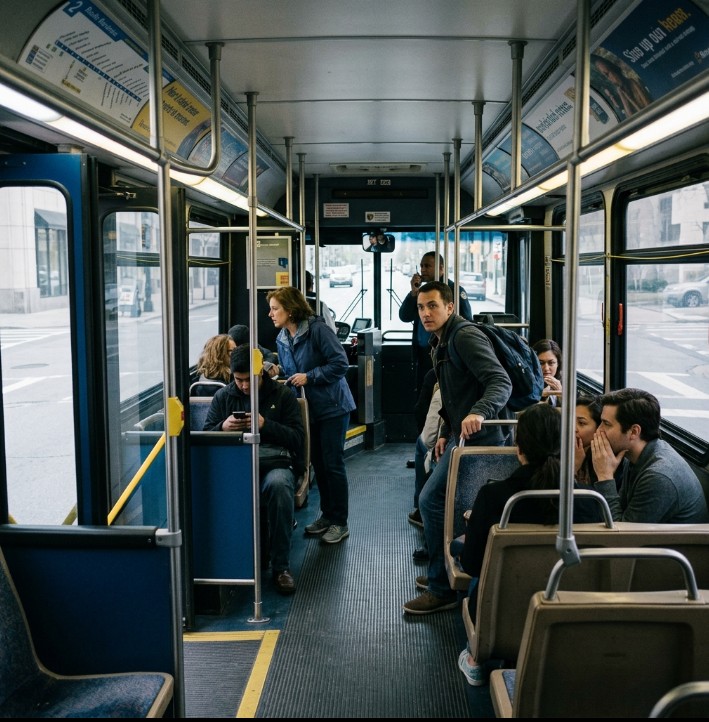
Describe what is unusual or unexpected in this picture. Say what is happening, why it stands out and what you would do in that situation.
Timing: 30s preparation, 60s speaking.
Sample high-scoring answer
What is unusual here is that a city bus has come to a complete stop in the middle of its route, and none of the passengers seem to be getting off. The doors are open, the engine is quiet, and the people inside are standing or half-risen from their seats, looking toward the front and talking quietly. A few are checking their phones or peering out of the window. What stands out is the stillness. A bus is normally a place of constant small movement, with people getting on and off at every stop, so everyone being frozen in place feels oddly tense. If I were there, I would stay calm, listen for an announcement from the driver, and ask the person beside me what had happened. If the wait dragged on, I would check the route on my phone and step outside to catch another bus.