CELPIP Speaking practice test: eight recorded tasks in 15–20 minutes. Preparation is tightly clocked and there is no live examiner mid-task.
Practise these tasks with timers →
Task 1 — Giving Advice
Your friend has just moved to Toronto and is deciding between living in a downtown condo and a suburban house. Provide advice on factors to consider.
Timing: 30s preparation, 90s speaking.
Sample high-scoring answer
If a friend had just moved to Toronto and was deciding between living downtown and living in the suburbs, I would tell them to spend a weekend in each area before signing a lease, because the two lifestyles are completely different. Living downtown near Bay Street or King West means you can walk to work, use the PATH underground network in winter, and reach restaurants, theatres, and nightlife within minutes of your door. The catch is the cost. A one-bedroom condo downtown can easily exceed twenty-five hundred dollars a month, and weekends can be noisy if you value peace and quiet. The alternative is a neighbourhood like Leslieville or the Beaches, which feels more like a small community inside the city, with tree-lined streets, independent coffee shops, and farmers markets. The trade-off is the commute, which can take forty-five minutes on the streetcar during rush hour. If my friend has a family or a dog, I would recommend the suburban option for the extra space and park access. If they are young and single, downtown makes more sense.
Task 2 — Talking About Personal Experience
Talk about a time you learned to use a new technology or digital tool that made an important task easier. What was the tool, why did you need it, and how did it change your routine?
Timing: 30s preparation, 60s speaking.
Sample high-scoring answer
A few years ago, my small bookkeeping business in Scarborough was struggling with receipts piling up everywhere. I was spending hours every week entering numbers manually into spreadsheets. A colleague recommended a cloud-based accounting app that could scan receipts with a phone camera and categorize expenses automatically. At first, I was hesitant because I am not particularly tech-savvy, but I decided to try it. The first week was challenging — I had to learn how to connect my bank account and set up expense categories. However, by the second week, I had reduced my paperwork time from six hours to just two. The app even flagged duplicate entries I had missed. Now I use it daily, and I have recommended it to three other small business owners. This experience taught me that investing time to learn a new tool pays off enormously in the long run.
Task 3 — Describing A Scene
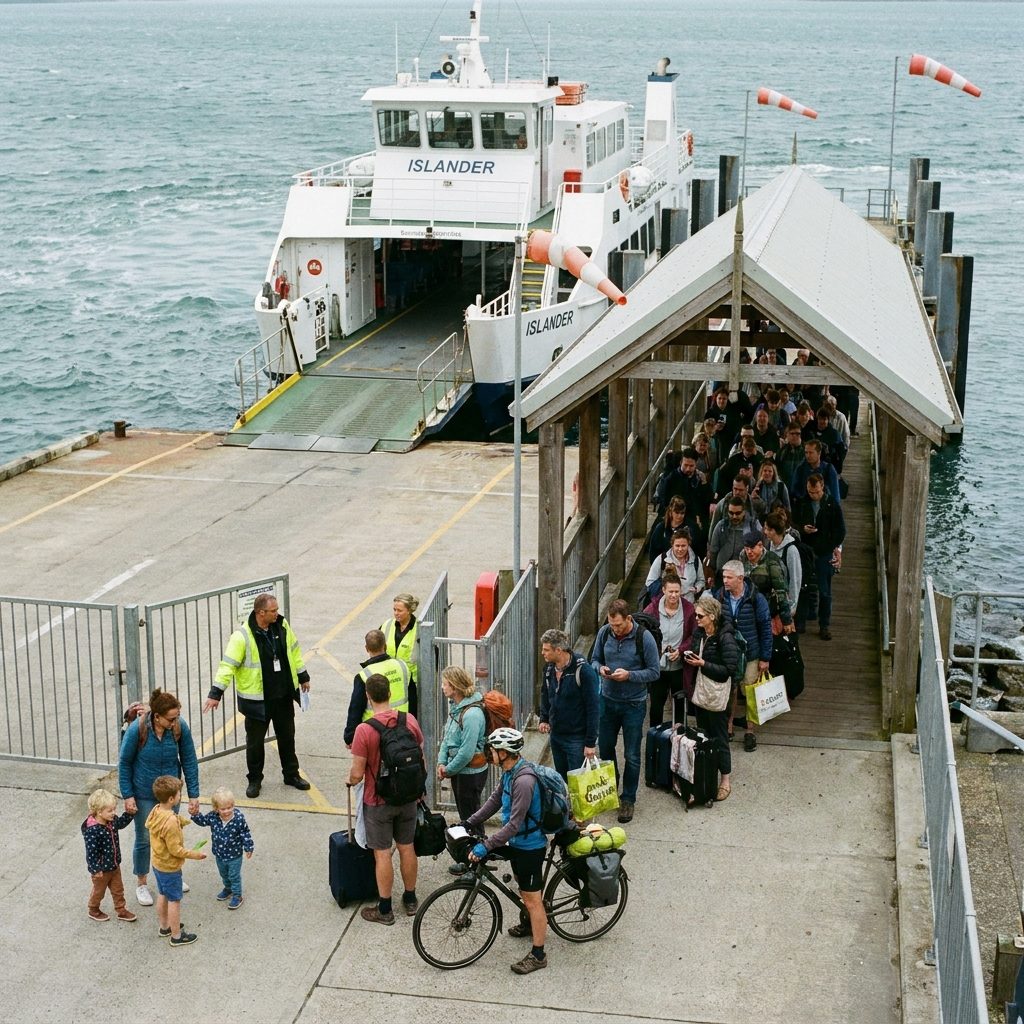
Describe the scene in the picture in as much detail as possible. Talk about the setting, the people, what they are doing and the atmosphere.
Timing: 30s preparation, 60s speaking.
Sample high-scoring answer
I'm looking at a ferry terminal on what looks like a bright but breezy day. The water is a flat grey-blue behind the dock, and a white ferry is tied up alongside, with its ramp lowered. In the foreground there is a queue of passengers waiting to board, and it snakes back along the covered walkway in a loose line. Most people are standing with backpacks, shopping bags or small suitcases, and several are looking at their phones or chatting in small groups. Near the front, a family with two young children is trying to keep them entertained, and a cyclist is standing beside a bike, waiting his turn. Staff in uniform are near the gate, directing people. The atmosphere is patient and orderly rather than stressful, and it feels like a normal weekday crossing.
Task 4 — Making Predictions
Look at the same picture again. Predict what happens next in this scene and explain why you think so.
Timing: 30s preparation, 60s speaking.
Sample high-scoring answer
In the same scene at the terminal, I think the next twenty minutes or so will follow the usual pattern of a boarding call. The ferry is already tied up with its ramp down and the staff are standing near the gate, so the gate will open and they will start letting people through in small groups. The queue will shuffle forward, the cyclist will wheel his bike up the ramp, and the family with the young children will move to the front with the rest of the foot passengers. Once everyone is aboard, the ramp will come up, the ferry will pull away from the dock, and the whole area will suddenly look empty. Then, within the hour, the next wave of passengers will start arriving for the return sailing, and the queue will form again in the same place.
Task 5 — Comparing And Persuading
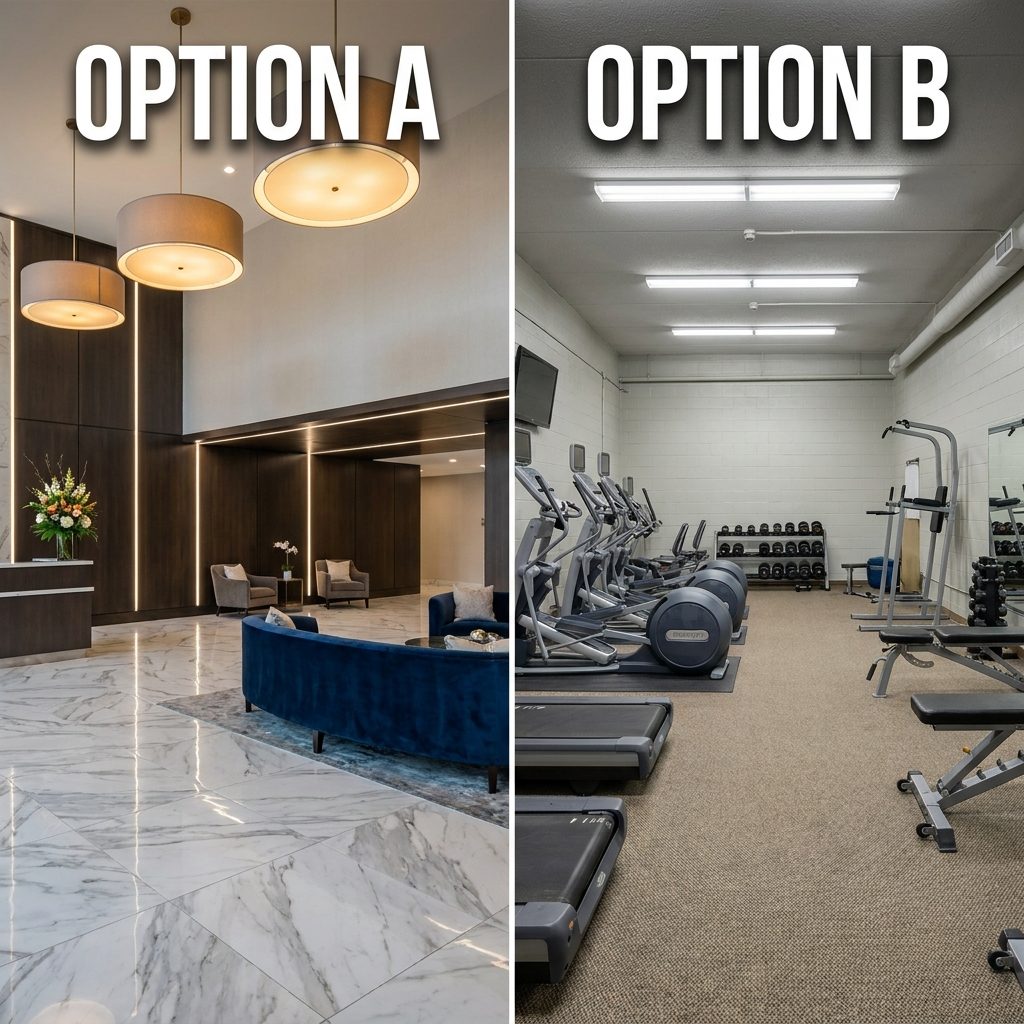
As condo board president, convince owners to approve a plan to renovate the lobby instead of upgrading the gym. Compare the benefits. Two options are shown as pictures A and B. Choose the one you would recommend and persuade the other person to agree with you. Use the pictures to support your reasons. Both options are shown in one picture, labelled A and B. Choose the one you would recommend and persuade the other person to agree with you. Use the picture to support your reasons.
Timing: 60s preparation, 60s speaking.
Sample high-scoring answer
As condo board president, I want to explain why we should approve the lobby renovation instead of upgrading the gym. I know a renovation means cost and disruption, but delaying it will cost us more. The lobby is the first thing potential buyers see when they walk in, and right now it looks dated, with stained carpet and dim lighting. Two units in our building sold below asking price this year, and both real estate agents mentioned the lobby. We can only afford one project this year, and the gym is used by a small number of owners, while every resident and visitor walks through the lobby. Renovating it protects the value of all our units, which benefits everyone. Finally, the contractor's preferred rate expires at the end of this quarter, so waiting means paying more for the same work.
Task 6 — Dealing With Difficult Situation
You are stuck in an elevator with two strangers during a power outage. Describe how you would handle the situation.
Timing: 60s preparation, 60s speaking.
Sample high-scoring answer
If I were stuck in an elevator with two strangers during a power outage, I would focus on keeping everyone calm. First, I would press the emergency call button and find out from the security team how long we might be waiting, because knowing that makes the situation far less frightening. Then I would introduce myself and start a friendly conversation to take everyone's mind off the situation. If one of them was breathing quickly and gripping her bag, I would ask about her day and let her talk about something she cares about. When we were told the backup generator would start soon, I would share that news out loud so that nobody felt forgotten. When we were finally freed, I would thank the two strangers and stay positive, because what could have been terrifying became strangely memorable.
Task 7 — Expressing Opinions
Express your opinion: Should the city invest more in public transit than in road infrastructure? Provide reasons.
Timing: 30s preparation, 90s speaking.
Sample high-scoring answer
I firmly believe that Toronto should invest more in public transit than in expanding roads, and I say that as someone who both drives and takes the TTC. Every time a city widens a highway, it fills up with more cars within a few years. That is called induced demand, and we have seen it on Highway 401 and the Gardiner Expressway, so we cannot build our way out of congestion. What we can do is give people a reliable alternative to driving. When the Eglinton Crosstown finally opens, it will connect neighbourhoods that have been underserved for decades and take thousands of cars off the road every day. Transit investment is also a question of fairness. Low-income families are far more likely to rely on buses and subways, and every dollar spent widening a road in a wealthy suburb is a dollar not spent improving bus service in Rexdale or Scarborough. It is better for the environment too, because every person who switches from driving to the subway or the GO Train reduces their carbon footprint by about two tonnes a year. Roads have their place, but the future of Toronto is on rails and buses.
Task 8 — Describing Unusual Situation
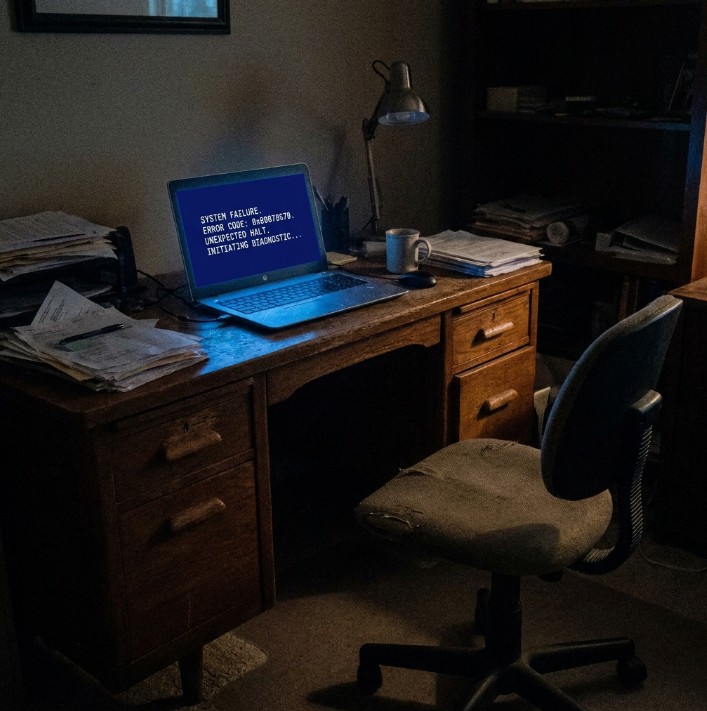
Describe what is unusual or unexpected in this picture. Say what is happening, why it stands out and what you would do in that situation.
Timing: 30s preparation, 60s speaking.
Sample high-scoring answer
What strikes me as unusual here is not the laptop itself but what is on the screen. It is an ordinary desk in an ordinary room, and the machine is switched on, but instead of a document the whole screen has been taken over by an error message. That is what stands out: equipment that is supposed to be doing useful work has simply stopped, and nobody is sitting at it. It is a bit unsettling, because there is no obvious physical damage and no clue about what went wrong, so anyone sitting there would feel stuck. If I were the one at that desk, I would read the message on the screen carefully, make a note of it, and then restart the machine. If that did not fix it, I would contact whoever supports it and describe exactly what I saw.