CELPIP Speaking practice test: eight recorded tasks in 15–20 minutes. Preparation is tightly clocked and there is no live examiner mid-task.
Practise these tasks with timers →
Task 1 — Giving Advice
A friend of yours just moved to Montreal and wants to get involved in the city’s arts and culture scene. Advise them on how to start networking and finding opportunities. What steps would you recommend?
Timing: 30s preparation, 90s speaking.
Sample high-scoring answer
If a friend just moved to Montreal and wanted to get involved in the arts scene, I would recommend a few specific things. First, the Belgo Building on Sainte-Catherine Street houses dozens of artist studios and galleries, and many of them host open studio events on the first Saturday of every month. They are free, and the artists are usually happy to chat about their work, so I would tell my friend to go with a small notebook and be genuinely curious rather than trying to sound knowledgeable about art. Second, the MURAL Festival and the jazz festival on the Plateau are always looking for volunteers, and that is one of the fastest ways to meet creative, energetic people. Volunteering gives you an instant purpose and community, and those relationships often last beyond the event itself. Third, I would suggest a class at the Visual Arts Centre in Westmount or a community workshop in the Mile End. Even if my friend is not an artist, a pottery or printmaking class is a great way to meet creative people. Finally, I would tell them to wander the independent galleries along Saint-Laurent and attend as many opening nights as possible.
Task 2 — Talking About Personal Experience
Talk about a time you worked with others to accomplish a shared goal. What was the project or task, what role did you play, and what was the result?
Timing: 30s preparation, 60s speaking.
Sample high-scoring answer
Last year the community garden near my apartment in Montreal's Plateau was at risk of closing because of funding cuts. About fifteen neighbours, including me, decided we could not let that happen. I organized a fundraising weekend market. I coordinated with local bakeries to donate pastries, made simple flyers, and set up a schedule so someone was always at the welcome table. What surprised me was how quickly everyone helped. One neighbour who is a musician played guitar, another brought homemade jam to sell, and a retired teacher ran a seed-planting workshop for children. By the end of the weekend we had raised over two thousand dollars, enough to cover the garden's costs for the whole season. More importantly, the event brought our neighbourhood closer together, and I learned that when a community rallies around something they care about, they can achieve far more than any individual alone.
Task 3 — Describing A Scene
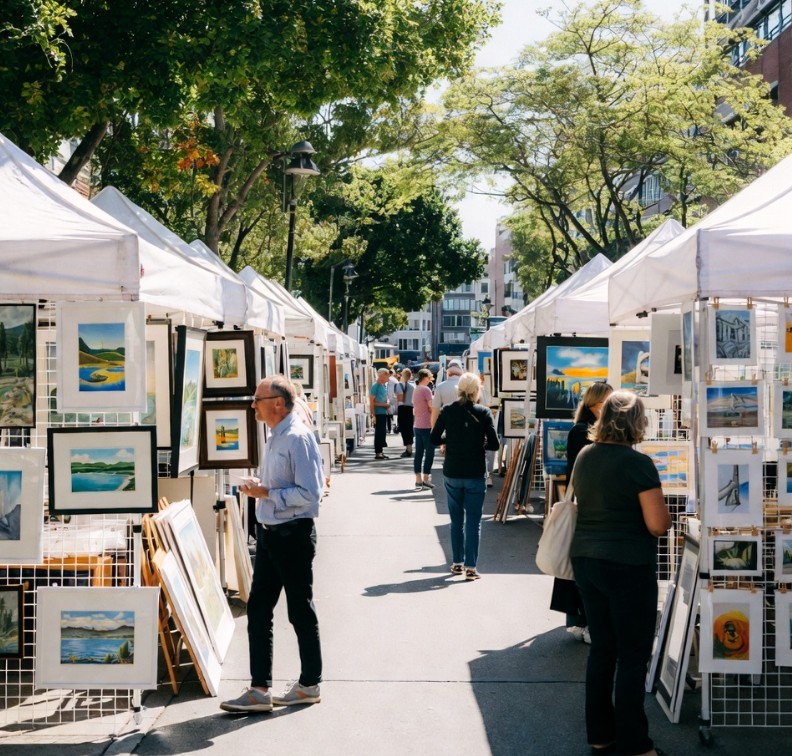
Describe the scene in the picture in as much detail as possible. Talk about the setting, the people, what they are doing and the atmosphere.
Timing: 30s preparation, 60s speaking.
Sample high-scoring answer
It is a bright, mild morning and I am standing in the middle of an outdoor art market that has taken over a wide pedestrian street. Rows of white canopies line both sides, and most of them are hung with paintings, so the whole street looks like one long open-air gallery. There are framed watercolours of hills and lakes, bright acrylic landscapes, and smaller sketches clipped to wire racks. The artists stand beside their stalls, some chatting with visitors, others quietly adjusting a canvas on an easel. A few people stop to study a painting closely, tilting their heads, and one woman is clearly discussing a price with a painter. Sunlight falls between the tents and throws soft shadows on the pavement. The mood is relaxed and friendly, busy without being crowded, and everyone seems happy just to wander and look.
Task 4 — Making Predictions
Look at the same picture again. Predict what happens next in this scene and explain why you think so.
Timing: 30s preparation, 60s speaking.
Sample high-scoring answer
I am still standing in the same art market, and I can predict the next couple of hours fairly confidently. It is only mid-morning and the weather is bright and mild, so more shoppers will arrive soon and the gaps between the stalls will fill with slow-moving crowds. The painters who are chatting quietly now will get busier, answering questions and wrapping paintings for buyers. The woman negotiating a price will probably settle on a figure and walk away with a canvas under her arm. As the sun climbs, the light on the canvases will change, so some artists will turn their easels or move a piece into the shade to keep the colours looking right. By early afternoon the most popular paintings will be gone, the stalls will look emptier, and the sellers will start thinking about packing up.
Task 5 — Comparing And Persuading
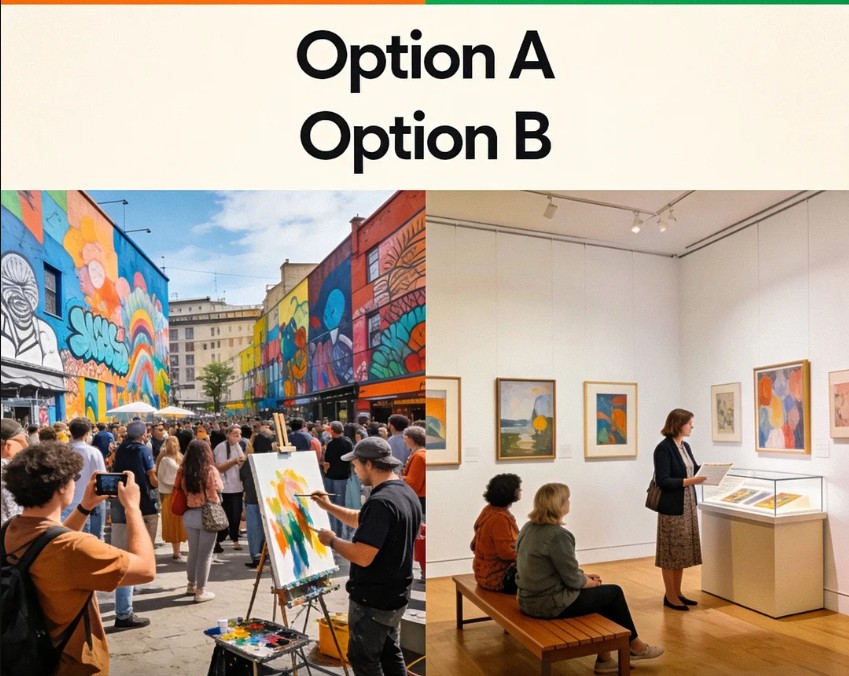
Compare the experience of visiting a large, international art festival like MURAL versus visiting a small, local gallery exhibition. Which experience do you think is more valuable for someone new to the art world? Persuade your listener. Two options are shown as pictures A and B. Choose the one you would recommend and persuade the other person to agree with you. Use the pictures to support your reasons. Both options are shown in one picture, labelled A and B. Choose the one you would recommend and persuade the other person to agree with you. Use the picture to support your reasons.
Timing: 60s preparation, 60s speaking.
Sample high-scoring answer
For someone new to the art world, I believe a local gallery exhibition is more valuable to start with. Large festivals like MURAL can be overwhelming, with massive crowds and so many different works that it is hard to really focus on any of them. A local gallery offers a much more intimate setting, where you can actually have meaningful conversations with the artist and ask questions. It also allows you to learn about the local art scene step by step, at your own pace. While festivals are exciting, they might not provide that personal connection that a gallery does. So I would persuade a beginner to start with small exhibitions first, to build confidence and understanding, and then later they can enjoy festivals with a much better appreciation. Local galleries are the best starting point.
Task 6 — Dealing With Difficult Situation
You are organizing a small outdoor art show in a Montreal park. On the morning of the event, you receive a call from the city saying that due to unexpected construction, the park is unavailable. You have 15 vendors and at least 50 visitors expected. What steps do you take to handle this situation?
Timing: 60s preparation, 60s speaking.
Sample high-scoring answer
First, I would stay calm and quickly start calling alternative venues, such as nearby community centres or school gyms, to see if any of them are free at short notice. I would also call the vendors to let them know about the problem and ask if any of them have suggestions. If we do secure a new location, I would update the event page, email all the attendees, and use social media to announce the change as quickly as possible. If it turns out that holding the event today is not possible, I would postpone it and email everyone with a new date. I would apologize sincerely and offer a small discount or free entry for the next event to maintain goodwill with both the vendors and the visitors. Communication is really the key in a situation like this, so I would make sure everyone knows what is happening.
Task 7 — Expressing Opinions
Some people believe that public funds should be used to support large art festivals, while others argue that this money should go to social programs. What is your opinion? Provide reasons to support your view.
Timing: 30s preparation, 90s speaking.
Sample high-scoring answer
I believe public funds should absolutely be used to support large arts festivals like the MURAL Festival in Montreal, and I think it is one of the smartest economic decisions a city can make. Every year the festival attracts tens of thousands of visitors to the Plateau, filling hotels, restaurants, and shops during what would otherwise be a quiet early summer. For every dollar the city contributes, multiple dollars flow back through tourism spending. But beyond the economics, there is a deeper reason to support these festivals. Public art transforms neighbourhoods. The murals stay on those walls for years, turning ordinary brick buildings into landmarks that people seek out and photograph. They give a neighbourhood an identity and make art accessible to people who might never set foot in a gallery. Festivals also create community pride, because when residents see their own streets celebrated on an international stage, it strengthens their connection to the city. Some people argue that public funds should go only to essential services, but I think that is a false choice: a city that invests in both practical infrastructure and cultural life is a city people want to live in.
Task 8 — Describing Unusual Situation
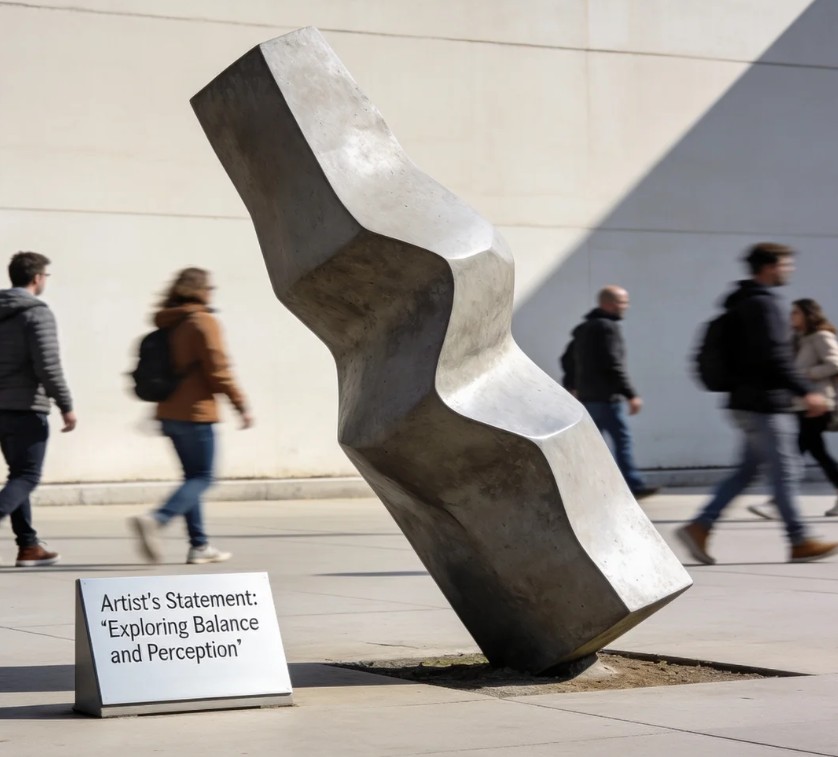
Describe what is unusual or unexpected in this picture. Say what is happening, why it stands out and what you would do in that situation.
Timing: 30s preparation, 60s speaking.
Sample high-scoring answer
What strikes me as unusual here is a piece of public sculpture standing in an ordinary open space, and it does not look like anything I would expect there. It is large, oddly shaped and clearly abstract, leaning at an angle that makes it look almost as if it is about to topple, yet it is solid and fixed to the ground. People around it are walking past as if it were completely normal, which makes it stand out even more, because the sculpture feels strange against the plain surroundings. It draws the eye because it is so different from everything else in the picture. If I were there, I would walk around it slowly and look at it from several angles to work out what it represents. Then I would take a photo and look for an information plaque to find out what the artist intended.