CELPIP Speaking practice test: eight recorded tasks in 15–20 minutes. Preparation is tightly clocked and there is no live examiner mid-task.
Practise these tasks with timers →
Task 1 — Giving Advice
A friend who is a new farmer is worried about the upcoming harvest season. What advice would you give them regarding weather monitoring, equipment maintenance, and stress management?
Timing: 30s preparation, 90s speaking.
Sample high-scoring answer
If a friend who is a new farmer in Saskatchewan were worried about the upcoming harvest season, I would offer a mix of practical advice and reassurance. First, I would recommend that they diversify their crops rather than relying on a single commodity like wheat or canola, because farmers who plant several crops are better protected against price drops or disease affecting any one variety. Even a small plot of lentils or oats can provide a financial buffer. Second, I would urge them to invest in soil moisture sensors and weather monitoring equipment. The technology has become much more affordable, and knowing when to irrigate or when to expect a dry spell can mean the difference between an average yield and a poor one. Third, I would encourage them to join a local farming cooperative. These groups share equipment, negotiate better prices on seed and fertilizer, and provide a network of experienced growers. When my neighbour's wheat was hit by an early frost two years ago, the co-op helped him secure bridge financing for the winter. Beyond the practical advice, I would remind my friend that farming has always been an occupation of uncertainty; the farmers who succeed are the ones who plan for the worst and lean on their community when times get tough.
Task 2 — Talking About Personal Experience
Talk about a time you visited or spent time in a small town or rural community. What did you notice that was different from city life, and what did you take away from the experience?
Timing: 30s preparation, 60s speaking.
Sample high-scoring answer
A few years ago I spent a long weekend visiting my cousin, who farms wheat near Swift Current, Saskatchewan. I grew up in Saskatoon, so I thought I knew what rural life was like, but staying on an actual working farm was eye-opening. My cousin woke up at five every morning, checked the weather radar, and spent hours in the fields. One evening a neighbour called to say his tractor had broken down, and within thirty minutes three other farmers arrived with tools to help fix it. Nobody asked for payment; they just helped because that is what neighbours do. In the city, I barely know the names of the people in my own building. I also noticed how dark and quiet the nights were, with stars I never saw from Saskatoon. That weekend made me appreciate the slower pace of rural life and the strength of small communities.
Task 3 — Describing A Scene
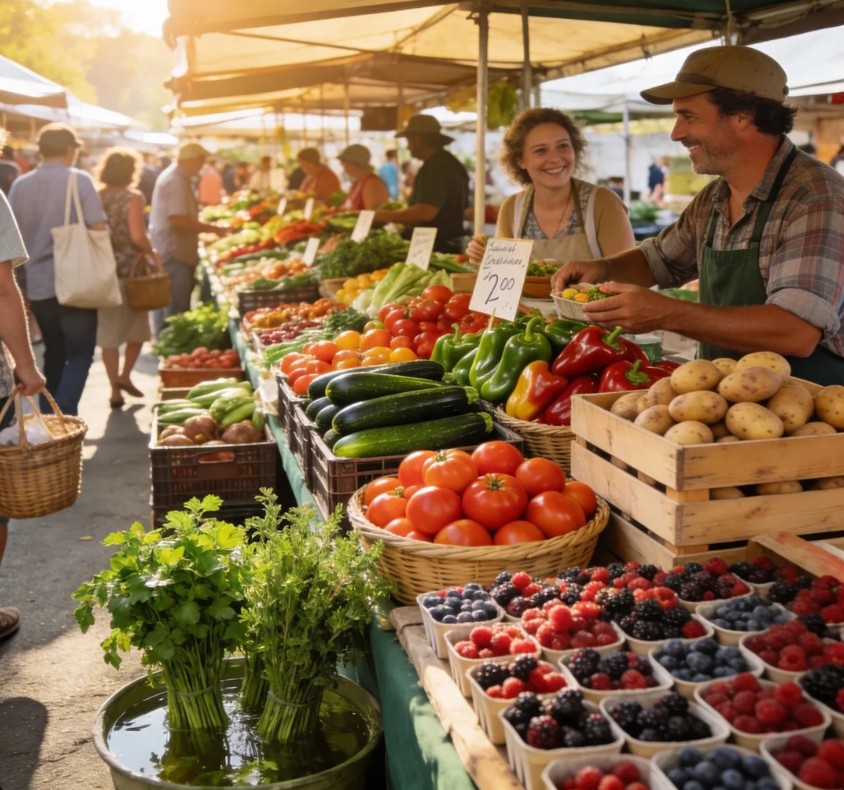
Describe the scene in the picture in as much detail as possible. Talk about the setting, the people, what they are doing and the atmosphere.
Timing: 30s preparation, 60s speaking.
Sample high-scoring answer
It is a warm summer morning and I am walking through a busy farmers market. The stalls are set out in long rows, and almost every one is piled high with fresh produce. There are crates of dark green zucchini, glossy peppers, baskets of tomatoes in several shades of red, and bundles of leafy herbs standing in water. One stall is completely covered with berries in small punnets, and beside it a farmer is stacking new potatoes into wooden boxes. The people behind the tables are cheerful and talkative, calling out prices and offering samples, while shoppers move slowly along the rows with cloth bags and baskets. Everything looks freshly picked, and the colours are incredibly vivid in the sunlight. The atmosphere is lively and friendly, full of conversation, and it feels like the whole community has come out to buy food straight from the people who grew it.
Task 4 — Making Predictions
Look at the same picture again. Predict what happens next in this scene and explain why you think so.
Timing: 30s preparation, 60s speaking.
Sample high-scoring answer
I am still looking at the same farmers market, and I can see what will happen over the next hour or two. It is already a warm summer morning, so the crowds will get thicker by midday and the queues at the busiest stalls will grow. The leafy herbs and soft berries will start to wilt in the heat, so the vendors will probably move those crates into the shade or sell them off cheaply before they spoil. The farmer stacking potatoes will finish filling his boxes and then start serving customers, and the berry stall will likely sell out first, because that produce looks the most tempting. As the morning wears on, shoppers will head home with full bags, the stalls will thin out, and the sellers will begin folding up their tables.
Task 5 — Comparing And Persuading
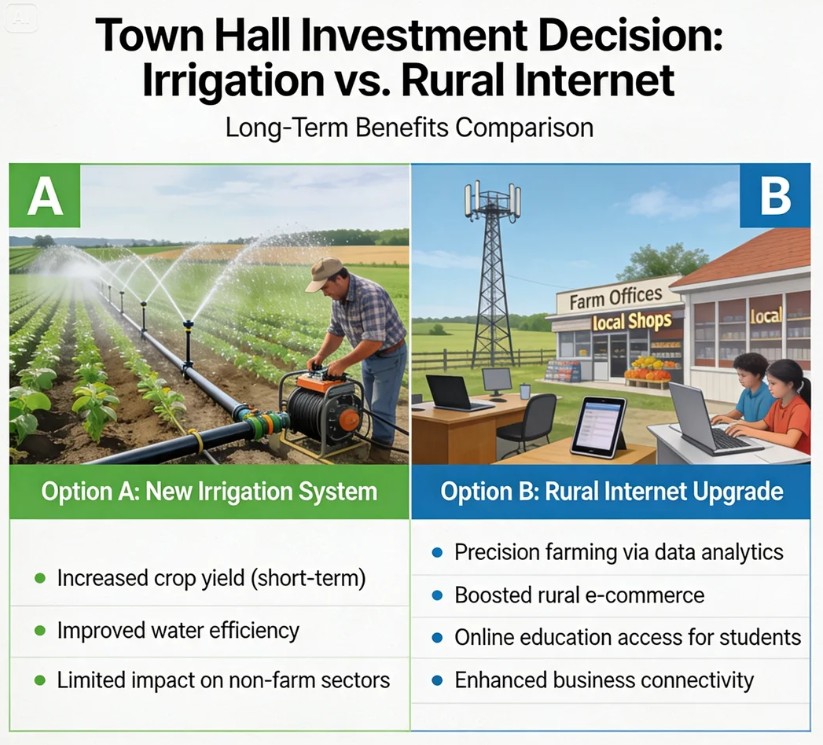
Your town hall is debating whether to invest in a new irrigation system for local farms or to upgrade the rural internet network. Compare the long-term benefits of each and persuade the council to prioritize internet. Consider how internet affects farms, businesses, and education. Two options are shown as pictures A and B. Choose the one you would recommend and persuade the other person to agree with you. Use the pictures to support your reasons. Both options are shown in one picture, labelled A and B. Choose the one you would recommend and persuade the other person to agree with you. Use the picture to support your reasons.
Timing: 60s preparation, 60s speaking.
Sample high-scoring answer
I would argue strongly for the town hall to invest in a new communal irrigation system. First, water security is the greatest challenge facing Saskatchewan agriculture. Last summer our area received only forty percent of its average rainfall, and six families I know saw their yields drop by half. A communal system pools resources so no single farmer bears the entire cost of drought protection. Second, a shared system is cheaper than every farm drilling its own wells and pumps, because together we could reach deeper aquifers and install drip irrigation that wastes far less water, and spread across thirty farms the annual payment is about the price of a used tractor. Third, reliable irrigation would let us grow higher-value crops that command premium prices at Saskatoon markets. Some will say we cannot afford it, but the real question is whether we can afford not to.
Task 6 — Dealing With Difficult Situation
You are a truck driver who has been asked to deliver emergency supplies to a rural community, but your truck breaks down halfway. Describe how you would handle this situation. What steps do you take to ensure the supplies still reach the community?
Timing: 60s preparation, 60s speaking.
Sample high-scoring answer
If I were a truck driver asked to deliver emergency supplies to a rural area cut off by a blizzard, I would be extremely cautious, because winter conditions in Saskatchewan turn deadly quickly. First, I would check road conditions through the provincial highway hotline and speak with the RCMP officer in charge. If the roads are impassable, I am not going, because adding a stranded truck helps no one. If the main highway is open but the side roads are closed, I would coordinate with the local emergency operations centre to set a meeting point, then transfer the supplies to snowmobiles for the final kilometres. Before leaving, I would pack a thermal sleeping bag, extra fuel, a shovel, a charged satellite phone, and food and water for two days. I would file a trip plan with my dispatcher, including my route and hourly check-ins, because courage is not recklessness.
Task 7 — Expressing Opinions
Do you think all rural communities should have free public Wi-Fi? Express your opinion and justify it with reasons related to equality, education, and economic development.
Timing: 30s preparation, 90s speaking.
Sample high-scoring answer
I believe all rural communities should have access to free public Wi-Fi, and I see this as a matter of basic fairness and economic necessity. Internet access is not a luxury; it is essential infrastructure, just like electricity and running water. Yet thousands of families in rural Saskatchewan still rely on slow, expensive satellite connections, or have no reliable internet at all. This has real consequences. Students cannot complete online homework, farmers cannot access real-time commodity pricing or weather forecasts, and seniors cannot use telehealth services without driving three hours to Saskatoon. The economic argument is equally strong. Young families will not move to a town where they cannot work remotely, and businesses will not invest in areas without reliable connectivity. If we want rural Saskatchewan to have a future, we need the infrastructure that makes that future possible. I do understand the cost concern; running fibre optic cables to a village of two hundred people is expensive per household. But I would argue the cost of not doing it is greater, measured in population decline, school closures, and lost opportunity. Free public Wi-Fi in community centres and libraries is a practical first step.
Task 8 — Describing Unusual Situation
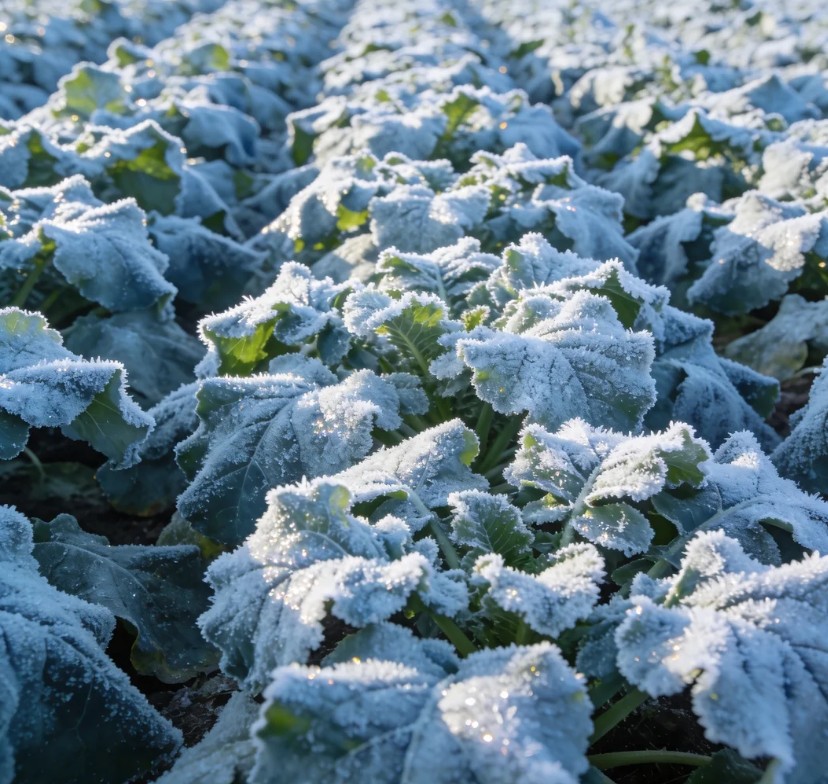
Describe what is unusual or unexpected in this picture. Say what is happening, why it stands out and what you would do in that situation.
Timing: 30s preparation, 60s speaking.
Sample high-scoring answer
What is unusual in this picture is that a field of crops is covered in a layer of white frost, even though the plants look like they belong in warm weather. It stands out because the scene looks almost like snow, but you can see the green leaves underneath, so it is clearly frost and not winter snow. The contrast between the living crop and the icy coating is what makes it so striking. It also looks unexpected for the time of year, which makes you worry about the harvest. If I were standing there, I would take a photograph first, because the light on the frozen leaves is beautiful. Then I would check how thick the frost is on the plants, because a hard frost can damage a crop, and I would tell the farmer or the landowner so they could decide whether anything needs to be done.