CELPIP Speaking practice test: eight recorded tasks in 15–20 minutes. Preparation is tightly clocked and there is no live examiner mid-task.
Practise these tasks with timers →
Task 1 — Giving Advice
A friend is moving to Mississauga and asks for advice on commuting to work in Toronto. Give advice on the best method.
Timing: 30s preparation, 90s speaking.
Sample high-scoring answer
I would absolutely recommend the GO Train as the best option for commuting from Mississauga to downtown Toronto. The Lakeshore West line is reliable, runs frequently during peak hours, and avoids the nightmare of Highway 401 traffic. My advice would be to buy a Presto card right away and set it to auto-reload so you never run out of fare at the last minute. I would also tell my friend to try a few different stations before settling on one. Port Credit has a nice community feel but limited parking, while Clarkson has a much larger lot. Cooksville is convenient if you live more centrally. She should also download the GO Transit app, which shows real-time train locations and alerts for any delays. One thing people do not think about is bringing layers because the platforms get windy in winter and there is not much shelter. If she works late some evenings, she should know that the last train leaves Union Station just after midnight, so she needs to plan accordingly. Overall, the GO Train has made my commute predictable and actually quite relaxing because I can read or listen to podcasts instead of gripping a steering wheel in traffic.
Task 2 — Talking About Personal Experience
Talk about a time you had to manage a busy schedule or balance multiple responsibilities. What strategies did you use, and what did you learn about time management?
Timing: 30s preparation, 60s speaking.
Sample high-scoring answer
Last year I was working full-time at a marketing agency in Toronto while taking an evening graphic design course at George Brown College. On top of that, my mother was recovering from surgery, so I was helping her with grocery shopping and appointments. For about three months I felt like I was running on a treadmill that would not stop. The turning point came when I sat down one Sunday and built a detailed weekly schedule on a shared digital calendar. I colour-coded everything and blocked out specific times for work, school and family. I also protected two hours every Wednesday evening just for myself. The schedule forced me to say no to some social invitations, which was hard at first, but my friends understood. I learned that being busy is not the same as being productive, and that protecting personal time matters as much as meeting deadlines.
Task 3 — Describing A Scene
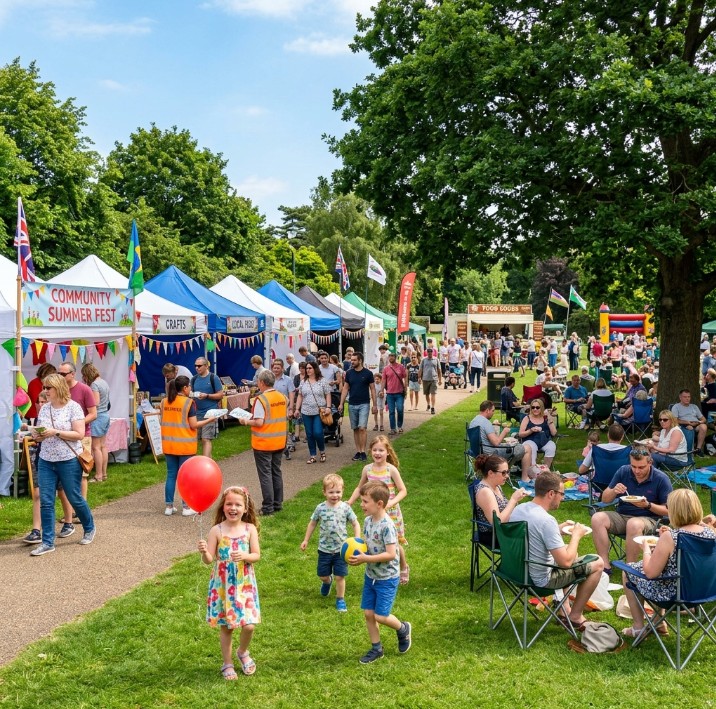
Describe the scene in the picture in as much detail as possible. Talk about the setting, the people, what they are doing and the atmosphere.
Timing: 30s preparation, 60s speaking.
Sample high-scoring answer
The picture shows a community park in the middle of a summer festival. It is a bright, sunny day and the grass is a deep green. Along one side of the park there is a row of small white and blue tents with tables underneath them, and flags and banners strung between the poles. In the open space in the middle, families are walking around and stopping at the stalls. A group of children is playing on the grass near the front, and one small child is holding a balloon. A few people are sitting on folding chairs in the shade of a large tree, eating and talking, while volunteers in bright vests stand near a table handing out leaflets. Everybody looks relaxed and cheerful, and the whole place feels busy, friendly and full of life.
Task 4 — Making Predictions
Look at the same picture again. Predict what happens next in this scene and explain why you think so.
Timing: 30s preparation, 60s speaking.
Sample high-scoring answer
Looking at the same park scene, I think the next couple of hours will be busy but quite predictable. As the afternoon goes on, more families will probably arrive, because this kind of event usually gets busier after lunch, and the food stalls will start to sell out. Around four or five o'clock the children will get tired and the crowd will begin to thin out, and the volunteers will start packing away the tables and folding the tents. The bins will be overflowing and the grass will be covered in litter, so somebody will have to tidy it up. By early evening I expect the park to be almost empty again, with just a few people carrying equipment back to their cars.
Task 5 — Comparing And Persuading
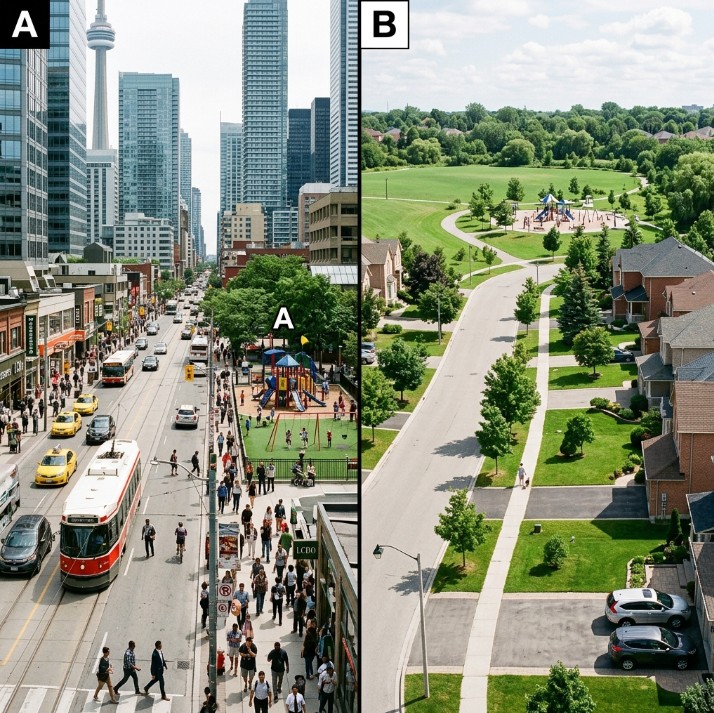
Compare living in a busy city like Toronto versus a suburb like Mississauga. Persuade which is better for raising a family. Two options are shown as pictures A and B. Choose the one you would recommend and persuade the other person to agree with you. Use the pictures to support your reasons. Both options are shown in one picture, labelled A and B. Choose the one you would recommend and persuade the other person to agree with you. Use the picture to support your reasons.
Timing: 60s preparation, 60s speaking.
Sample high-scoring answer
I have experienced both lifestyles, and I am convinced Mississauga is the better choice for raising a family. Cost is the biggest factor. A three-bedroom house in Toronto's west end costs well over a million dollars, while in Mississauga you can find something similar for much less, with a backyard for the kids to play in. Safety matters too. Toronto has wonderful neighbourhoods, but Mississauga consistently ranks among the safest large cities in Canada, and that peace of mind is priceless with young children. Green space is another point. Mississauga has over four hundred parks and trails along the Credit River, so families reach nature without driving to cottage country. Toronto wins on cultural variety and nightlife, but for parents whose kids are in bed by nine, school quality, quiet streets and affordable space matter more. Mississauga gives my family room to grow.
Task 6 — Dealing With Difficult Situation
Your child's school bus is cancelled this morning, and you have an important meeting. Explain how you will manage the situation.
Timing: 60s preparation, 60s speaking.
Sample high-scoring answer
The moment I see the cancellation message, I would call my neighbour Sarah, who has a son in the same class and works from home on Tuesdays. If she can drive the kids, I would drop my daughter off at her house with a packed lunch. If Sarah is unavailable, I would text my manager that I will be thirty minutes late and use a ride-share to get my child to school. In parallel, I would start a group chat with two other parents so we have backup carpooling next time. Later in the day I would call the school transportation office to ask why our route keeps being cut and whether there is a long-term fix. The most important thing is not to panic, because children pick up on parental stress. By planning ahead and building a network of neighbours, a cancellation does not derail my whole day.
Task 7 — Expressing Opinions
Do you think schools should provide bus services for all students? Express your opinion with reasons.
Timing: 30s preparation, 90s speaking.
Sample high-scoring answer
I strongly believe that school bus services should be provided for all students, and I see this as a matter of fairness and safety. In suburban areas like Mississauga, many children live several kilometres from their school, often along roads without sidewalks or safe pedestrian crossings. Expecting a seven-year-old to walk forty minutes along a busy arterial road in January is simply unreasonable. Beyond safety, there is an equity argument. Families who cannot afford a car or who work shifts that prevent them from doing school drop-offs depend entirely on bus service. If we cut buses, we are essentially making education harder to access for lower-income families, which is the opposite of what a public school system should do. I also think buses reduce traffic congestion and pollution by taking dozens of individual cars off the road each morning. The cost of operating buses is real, but the cost of not operating them is paid by children standing in the cold and parents losing work hours. Every child deserves a safe ride to school, no matter where they live or what their parents earn.
Task 8 — Describing Unusual Situation
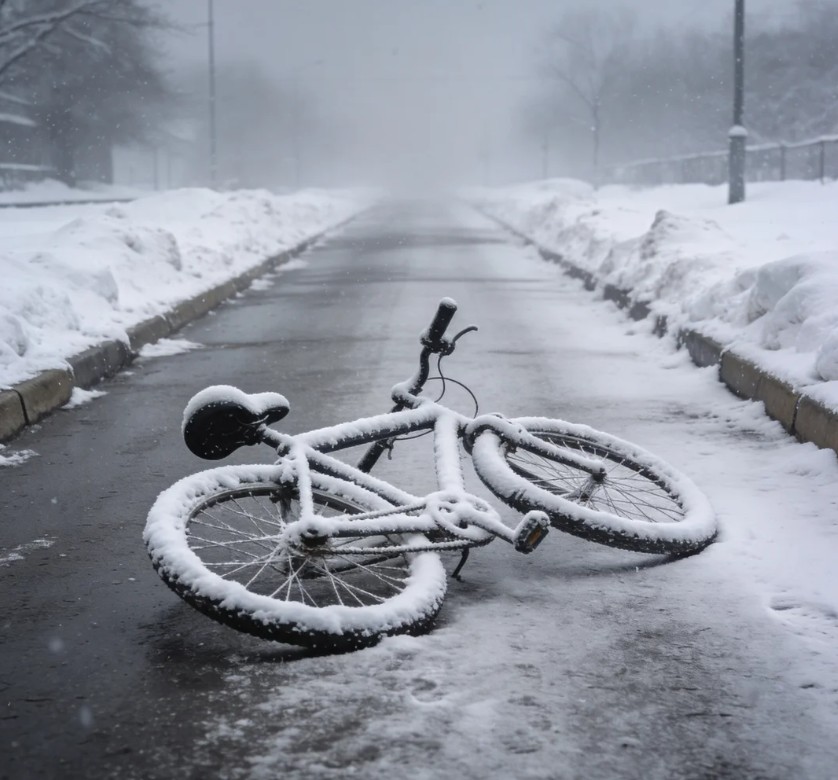
Describe what is unusual or unexpected in this picture. Say what is happening, why it stands out and what you would do in that situation.
Timing: 30s preparation, 60s speaking.
Sample high-scoring answer
What is unusual about this picture is the bicycle sitting in the middle of a snowy winter street. Everything around it looks like a normal cold morning, with snow banked up along the kerb and a grey sky, but this one bike has been left right there in the snow and is half covered. Its saddle, handlebars and frame are all dusted white, and there are no footprints or tracks beside it, which makes it look as though somebody simply abandoned it and walked away. That is what stands out, because people normally take their bikes indoors in this weather. If I saw it, I would not just leave it there. I would look around for the owner, and if nobody was about I would move it out of the road so it did not get damaged, then mention it to a nearby shop.