CELPIP Speaking practice test: eight recorded tasks in 15–20 minutes. Preparation is tightly clocked and there is no live examiner mid-task.
Practise these tasks with timers →
Task 1 — Giving Advice
Your friend has just moved to Edmonton and is looking for ways to meet new people. You have been living in Edmonton for five years. What advice would you give them?
Timing: 30s preparation, 90s speaking.
Sample high-scoring answer
If a friend had just moved to Edmonton and wanted to meet people, I would recommend a few approaches that have worked for people I know. First, Edmonton has a great network of recreational sports leagues through the Edmonton Sport and Social Club. They offer everything from dodgeball to curling, and the leagues are designed to be social, with pub nights after the games. I would suggest picking a beginner-level league, because the focus is more on meeting people than on competition. Second, the River Valley trail system is one of the largest urban parks in North America, and there are dozens of running, hiking, and cycling groups that organize regular outings. The November Project, which meets for free outdoor workouts on Wednesday mornings, is especially welcoming to newcomers. Third, I would recommend volunteering at one of Edmonton's many festivals, such as the Fringe Festival or Ice on Whyte. Working alongside other people toward a shared goal is a natural way to form friendships. Finally, I would tell my friend not to underestimate simply becoming a regular at a neighbourhood coffee shop. Edmontonians are famously friendly, and the key is consistency and being willing to say yes to invitations, even when it feels a little uncomfortable at first.
Task 2 — Talking About Personal Experience
Talk about a time you spent outdoors or participated in a recreational activity that was particularly memorable. Where did you go, what did you do, and why does it stand out in your memory?
Timing: 30s preparation, 60s speaking.
Sample high-scoring answer
Two summers ago, my brother and I hiked the Skyline Trail in Jasper National Park. We had been planning the trip for months, checking weather forecasts and training on shorter trails near Edmonton. The first day was challenging, because we gained over eight hundred metres of elevation, and my legs were burning by the time we reached the campsite. But when we woke up the next morning, the view was absolutely breathtaking. We could see three mountain ranges, a glacial lake below us, and a family of mountain goats grazing nearby. We sat in silence for nearly twenty minutes, taking it all in, and that moment felt almost spiritual. The hike reminded me that Alberta has world-class natural beauty right in our backyard, so I promised myself I would explore more of it. Since then, hiking has become an annual tradition, and I feel healthier and happier because of it.
Task 3 — Describing A Scene
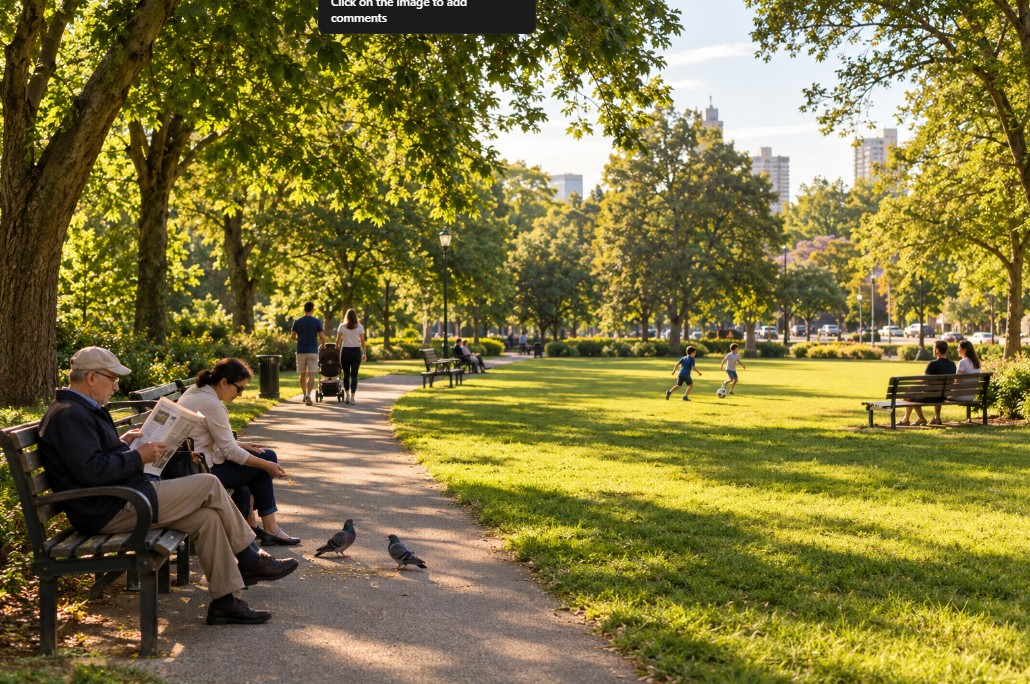
Describe the scene in the picture in as much detail as possible. Talk about the setting, the people, what they are doing and the atmosphere.
Timing: 30s preparation, 60s speaking.
Sample high-scoring answer
It is a warm, sunny afternoon in a city park, and the light is bright and golden across the grass. The photograph shows a wide open lawn surrounded by mature trees in full green leaf, with a few benches placed along the edge of a paved path. On one bench, an older man sits reading a newspaper, and beside him a woman is feeding crumbs to a pair of pigeons that have gathered at her feet. Further along the path, a young couple pushes a stroller, and two children chase a ball across the grass while their parents watch from another bench. The shadows under the trees are long and soft, and there is hardly any wind. The atmosphere is calm and unhurried. You can almost hear the birds and the distant traffic, and the whole scene feels like an ordinary weekend afternoon that people are quietly enjoying.
Task 4 — Making Predictions
Look at the same picture again. Predict what happens next in this scene and explain why you think so.
Timing: 30s preparation, 60s speaking.
Sample high-scoring answer
I am looking at the same sunny park, and I can easily say what will happen next. Because the afternoon is still warm and bright, the benches will stay full, and within the next hour or so more families will drift in with blankets and snacks. The two children chasing the ball will keep running until they get tired, and then they will probably flop down on the grass near their parents. The woman feeding the pigeons will run out of crumbs soon, so the birds will lose interest and wander back towards the trees. The older man with the newspaper will most likely finish reading, fold it up, and walk slowly home before the light starts to fade. As the sun drops lower, the shadows will stretch across the lawn, the stroller couple will head for the gate, and the park will slowly empty out.
Task 5 — Comparing And Persuading
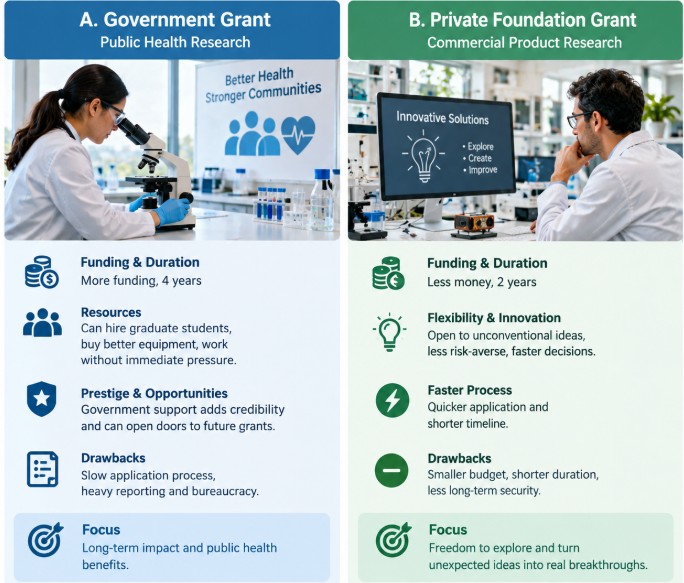
A university researcher is deciding between two research grants: one from a government agency and one from a private company. The government grant is for four years for a public health project, while the private grant is for two years for a commercial product. Compare the two and persuade the researcher to choose one. Two options are shown as pictures A and B. Choose the one you would recommend and persuade the other person to agree with you. Use the pictures to support your reasons. Both options are shown in one picture, labelled A and B. Choose the one you would recommend and persuade the other person to agree with you. Use the picture to support your reasons.
Timing: 60s preparation, 60s speaking.
Sample high-scoring answer
If I were a researcher choosing between a government grant and a private foundation grant, I would weigh the trade-offs. The government grant offers more funding and a longer timeline, so I could hire graduate students, purchase better equipment, and work without the pressure of showing immediate results. Government funding also carries prestige that can open doors to future grants. However, the application process is slow, and the reporting requirements are extensive and bureaucratic. The private foundation grant, by contrast, offers less money but greater flexibility. It is specifically interested in innovative research, so I could explore unconventional approaches that a government panel might consider too risky, and the application process is faster. In the end, I would choose the private foundation grant, because the freedom to pursue unexpected results is where important discoveries happen. I would apply for the government grant later, using those results as proof of concept.
Task 6 — Dealing With Difficult Situation
You are a city planner in Edmonton. You are leading a public meeting where residents are angry about a new road construction project that will cut through a part of the River Valley. Explain how you would handle the situation and propose a solution to the residents.
Timing: 60s preparation, 60s speaking.
Sample high-scoring answer
If I were leading a public meeting and residents were visibly upset, I would acknowledge their emotions before presenting any facts. I would start by thanking them for coming and saying that their frustration is understandable, because that usually helps people feel heard. Then I would present the data clearly, using slides that show traffic studies from other Canadian cities where similar bike lanes were installed. I would point to Calgary's experience, where protected bike lanes on Seventh Street actually reduced congestion by taking cyclists out of the general traffic flow. If residents were worried about parking, I would show the parking impact study and explain how many spots would be affected. Finally, I would open the floor for structured questions, with a note-taker recording every comment, and afterwards I would send everyone a summary with clear next steps. Most people just need to feel that the process was fair.
Task 7 — Expressing Opinions
Some people believe that the government should provide free public transit for all residents in large cities. What is your opinion? Provide reasons to support your view.
Timing: 30s preparation, 90s speaking.
Sample high-scoring answer
I believe that providing free public transit for all residents is an admirable goal, but I am not convinced it is the most practical or fair way to invest public funds right now, especially in a sprawling city like Edmonton. The cost of making the entire ETS system free would run into hundreds of millions of dollars annually, and that money would have to come from somewhere, most likely property taxes or cuts to other services. Instead, I think we should make transit much more affordable for the people who need it most. Expanding the Ride Transit Program, which offers subsidized passes to low-income residents, would target funding where it makes the biggest difference. A senior living on a fixed income in Mill Woods should not have to choose between buying groceries and buying a bus pass. We also need to improve the service itself. The number one reason people do not take transit in Edmonton is not the cost; it is the frequency and reliability of the buses, especially on the outskirts. If we invested in higher frequency on core routes and better coverage in underserved areas, ridership would increase naturally. Free transit sounds good in a campaign slogan, but affordable, reliable transit that people can actually depend on is a better long-term goal.
Task 8 — Describing Unusual Situation
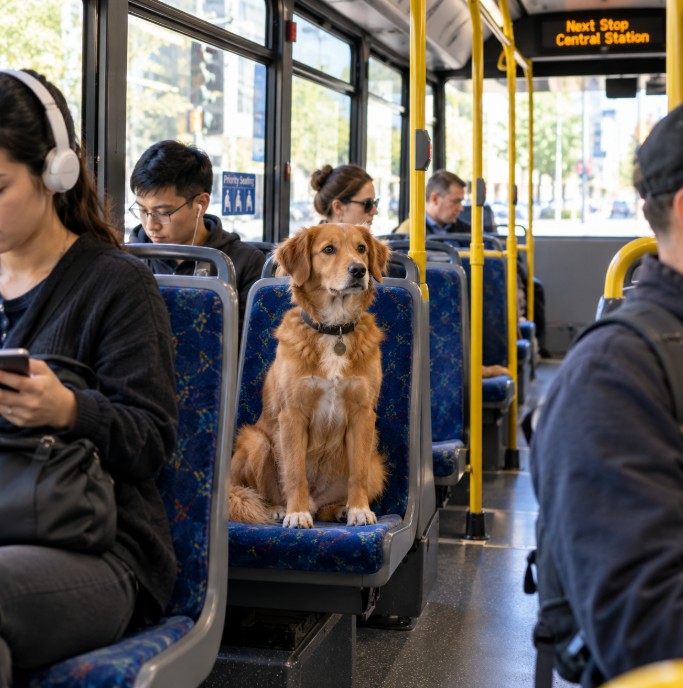
Describe what is unusual or unexpected in this picture. Say what is happening, why it stands out and what you would do in that situation.
Timing: 30s preparation, 60s speaking.
Sample high-scoring answer
What makes this picture unusual is a medium-sized dog sitting calmly on a passenger seat of a city bus, as if it were an ordinary commuter. It is not in a carrier, and no owner is holding its leash. The dog is upright and facing forward, its paws on the edge of the seat, and it looks completely relaxed. What stands out to me is the contrast: buses are usually full of people in a hurry, and a dog taking a seat where a person might sit feels funny and slightly out of place. The other passengers seem to ignore it. If I were on that bus, I would keep my distance, avoid startling the animal, and quietly ask the driver whether the dog belongs to someone on board. If no owner appeared, I would let the driver deal with it rather than move the dog myself.